
Container Chassis Inspection Checklist Before Port Dispatch
Container Chassis Inspection Checklist Before Port Dispatch
Container chassis inspection is a practical dispatch habit, not just a yard form. For port transfer, inland depot work, and cross-border container routes, a small fault at the twist lock, frame, lights, tires, or brake line can delay loading or create a serious road risk. This checklist helps fleet managers, drivers, and loading supervisors inspect a skeletal trailer before a container leaves the yard.

Start with the Container Assignment
A useful container chassis inspection begins before anyone walks around the trailer. Confirm the container size, expected gross weight, cargo sensitivity, route restrictions, pickup time, and receiving yard rules. A 20-foot container, 40-foot container, and mixed depot schedule can place different demands on lock positions, axle loading, and driver visibility.
If the dispatch team changes the assignment, repeat the container chassis inspection instead of assuming the trailer is still ready. The trailer may be mechanically sound but wrong for the box position or route condition.
Check the Frame and Main Beams
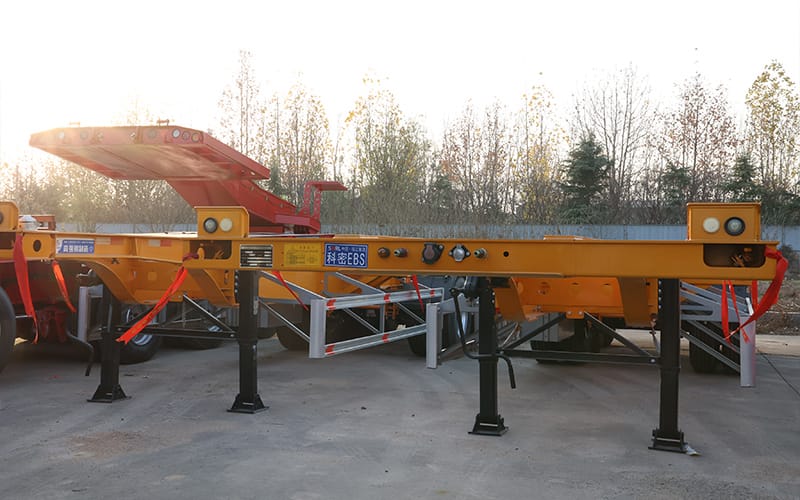
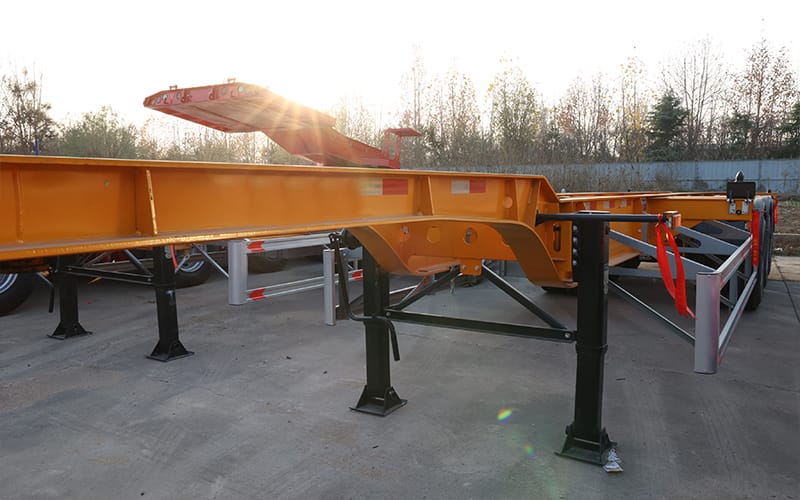
Walk the full length of the chassis and look for cracked welds, fresh deformation, loose cross members, severe corrosion, missing fasteners, or impact marks around the kingpin area. Pay attention to areas that carry repeated stress: landing gear mounts, suspension brackets, rear bolster, and container support points. Container chassis inspection should also include any repair areas from previous yard damage.
Inspect Twist Locks Before Loading
Twist locks are the direct connection between the container and the trailer. Make sure each lock turns freely, seats fully, and shows no visible cracking, bending, heavy wear, or missing handle components. Clean mud, rust flakes, and debris away from the lock pocket before loading. A container chassis inspection is incomplete until every active lock position is checked against the container size being carried.
The basic concept of a twistlock is simple, but poor locking discipline can still cause major problems. After the container is set down, confirm the lock position again before the unit moves.
Review Tires, Brakes, and Suspension
Container work often involves short moves, tight turns, rough yards, and frequent braking. Check tire pressure, tread condition, sidewall cuts, wheel nuts, brake chambers, air lines, suspension springs or airbags, and visible leaks. During container chassis inspection, treat uneven tire wear as a clue: it may point to axle alignment, suspension damage, or repeated overloading.
Container Chassis Inspection Dispatch Checklist
A written container chassis inspection checklist gives drivers a clear pass-or-stop standard and helps supervisors compare defects between shifts.
| Check area | What to confirm | Dispatch risk reduced |
|---|---|---|
| Frame | No cracks, loose brackets, or impact damage | Structural failure and yard rejection |
| Twist locks | Correct positions, clean pockets, full locking action | Container movement during transport |
| Running gear | Tires, brakes, suspension, and air lines are roadworthy | Breakdowns and enforcement delays |
| Lights and markers | Brake lights, turn signals, side markers, and reflectors work | Poor visibility in port and highway traffic |
| Documents | Container number, seal number, route notes, and driver handover are clear | Delivery disputes and wrong-container movement |
Confirm Lights, Markings, and Documents
Electrical faults are easy to ignore in daylight but costly at the gate. Test tail lights, brake lights, indicators, side markers, license plate lights, reflective tape, and the electrical connector. For night shifts, container chassis inspection should include a second look at weak lamps and damaged marker lenses. Container chassis inspection should finish with the paperwork: container number, seal number, gross weight, driver details, pickup location, delivery address, and any special yard instruction.
Match the Trailer to the Route
A checklist cannot fix a poor equipment match. For regular container work, review axle layout, suspension type, lock configuration, tare weight, turning radius, and maintenance access. Buyers comparing a Skeletal Semi-Trailer should connect the specification to normal container sizes, road conditions, tractor capacity, and loading frequency.
Yard-only moves, port-to-warehouse routes, and long highway transfers do not create the same duty cycle. A fleet that handles mixed logistics should also review General Logistics Transport requirements before standardizing one trailer setup.
Build the Routine into Daily Work
The best container chassis inspection routine is short, repeatable, and easy to audit. Assign responsibility, record defects immediately, keep container chassis inspection records with the work order, and stop dispatch when a lock, brake, tire, or frame issue is unresolved. Drivers should not be pressured to accept a trailer that has not passed the same process used for every other container move.
For fleet buyers, container chassis inspection results are also useful procurement feedback. Repeated problems around lock access, wiring protection, suspension wear, or landing gear position may show where the next trailer specification should be improved. When the checklist becomes part of daily dispatch, the fleet gains safer container handling, fewer gate delays, and clearer maintenance priorities.
Talk to YF Trailer
If your team needs a skeletal trailer for port transfer, container depot work, or cross-border logistics, share your normal container sizes, payload range, road conditions, and inspection concerns with YF Trailer. The team can help review a practical chassis configuration for your operation.
Blog Categories
Contact Us
Latest News
-
Semi Trailer Electrical Inspection Checklist Before Fleet Dispatch
-

Semi Trailer Tire Maintenance Checklist for Long-Distance Fleets
-

Multi-Axle Trailer Guide: How to Choose the Right Axle Configuration for Heavy Cargo
-

Flatbed Trailer Tie Down Point Inspection Before Industrial Loads
-

Duplicate Draft – Special Purpose Trailer Maintenance Schedule
-

Hazardous Transport: Yufei Tanker, Safe and Compliant
-

Flatbed Trailer Loading Surface Guide for Machinery Buyers
-

Supply Chain Collaboration, Trailers Build Industry-Academia Ecosystem
-
Hydraulic Trailer System Inspection Guide for Heavy Haul Work
-
Semi Trailer Maintenance Records Guide for Fleet Buyers
-
Multi Axle Trailer Guide for Heavy Equipment Transport
-
Semi Trailer Lighting Inspection for Night Loading and Yard Safety
-
Semi Trailer Load Distribution Guide for Safer Heavy Cargo Transport
-

Semi Trailer Trucks: How to Choose the Right One for Your Business
-

Lowboy Trailer Tire Clearance Guide for Heavy Equipment Loads
-
Rear Dump Trailer Tailgate Seal Inspection for Wet Material Loads
-

Customized Semi Trailer Solutions & Special Purpose Vehicles for Modern Transportation
-
Container Chassis Inspection Checklist Before Port Dispatch
-

Heavy Equipment Transport: Complete Guide to Oversized Cargo Logistics
View our industry solutions
Or learn about other industry content
Container chassis inspection is a practical dispatch habit, not just a yard form. For port transfer, inland depot work, and cross-border container routes, a small fault at the twist lock, frame, lights, tires, or brake line can delay loading or create a serious road risk. This checklist helps fleet managers, drivers, and loading supervisors inspect a skeletal trailer before a container leaves the yard.
Start with the Container Assignment
A useful container chassis inspection begins before anyone walks around the trailer. Confirm the container size, expected gross weight, cargo sensitivity, route restrictions, pickup time, and receiving yard rules. A 20-foot container, 40-foot container, and mixed depot schedule can place different demands on lock positions, axle loading, and driver visibility.
If the dispatch team changes the assignment, repeat the container chassis inspection instead of assuming the trailer is still ready. The trailer may be mechanically sound but wrong for the box position or route condition.
Check the Frame and Main Beams
Walk the full length of the chassis and look for cracked welds, fresh deformation, loose cross members, severe corrosion, missing fasteners, or impact marks around the kingpin area. Pay attention to areas that carry repeated stress: landing gear mounts, suspension brackets, rear bolster, and container support points. Container chassis inspection should also include any repair areas from previous yard damage.
Inspect Twist Locks Before Loading
Twist locks are the direct connection between the container and the trailer. Make sure each lock turns freely, seats fully, and shows no visible cracking, bending, heavy wear, or missing handle components. Clean mud, rust flakes, and debris away from the lock pocket before loading. A container chassis inspection is incomplete until every active lock position is checked against the container size being carried.
The basic concept of a twistlock is simple, but poor locking discipline can still cause major problems. After the container is set down, confirm the lock position again before the unit moves.
Review Tires, Brakes, and Suspension
Container work often involves short moves, tight turns, rough yards, and frequent braking. Check tire pressure, tread condition, sidewall cuts, wheel nuts, brake chambers, air lines, suspension springs or airbags, and visible leaks. During container chassis inspection, treat uneven tire wear as a clue: it may point to axle alignment, suspension damage, or repeated overloading.
Container Chassis Inspection Dispatch Checklist
A written container chassis inspection checklist gives drivers a clear pass-or-stop standard and helps supervisors compare defects between shifts.
| Check area | What to confirm | Dispatch risk reduced |
|---|---|---|
| Frame | No cracks, loose brackets, or impact damage | Structural failure and yard rejection |
| Twist locks | Correct positions, clean pockets, full locking action | Container movement during transport |
| Running gear | Tires, brakes, suspension, and air lines are roadworthy | Breakdowns and enforcement delays |
| Lights and markers | Brake lights, turn signals, side markers, and reflectors work | Poor visibility in port and highway traffic |
| Documents | Container number, seal number, route notes, and driver handover are clear | Delivery disputes and wrong-container movement |
Confirm Lights, Markings, and Documents
Electrical faults are easy to ignore in daylight but costly at the gate. Test tail lights, brake lights, indicators, side markers, license plate lights, reflective tape, and the electrical connector. For night shifts, container chassis inspection should include a second look at weak lamps and damaged marker lenses. Container chassis inspection should finish with the paperwork: container number, seal number, gross weight, driver details, pickup location, delivery address, and any special yard instruction.
Match the Trailer to the Route
A checklist cannot fix a poor equipment match. For regular container work, review axle layout, suspension type, lock configuration, tare weight, turning radius, and maintenance access. Buyers comparing a Skeletal Semi-Trailer should connect the specification to normal container sizes, road conditions, tractor capacity, and loading frequency.
Yard-only moves, port-to-warehouse routes, and long highway transfers do not create the same duty cycle. A fleet that handles mixed logistics should also review General Logistics Transport requirements before standardizing one trailer setup.
Build the Routine into Daily Work
The best container chassis inspection routine is short, repeatable, and easy to audit. Assign responsibility, record defects immediately, keep container chassis inspection records with the work order, and stop dispatch when a lock, brake, tire, or frame issue is unresolved. Drivers should not be pressured to accept a trailer that has not passed the same process used for every other container move.
For fleet buyers, container chassis inspection results are also useful procurement feedback. Repeated problems around lock access, wiring protection, suspension wear, or landing gear position may show where the next trailer specification should be improved. When the checklist becomes part of daily dispatch, the fleet gains safer container handling, fewer gate delays, and clearer maintenance priorities.
Talk to YF Trailer
If your team needs a skeletal trailer for port transfer, container depot work, or cross-border logistics, share your normal container sizes, payload range, road conditions, and inspection concerns with YF Trailer. The team can help review a practical chassis configuration for your operation.
Blog Categories
Contact Us
Latest News
-

Tanker Semi Trailer Valve Inspection Checklist Before Dispatch
-
Customized Semi Trailer Solutions & Special Purpose Vehicles for Modern Transportation
-
Lowbed Trailer Capacity: Complete Guide for Heavy Equipment Transport
-

Heavy Loads Secured: Yufei Low-Deck Trailer
-

Lowbed Trailer vs Flatbed Trailer: Which One Is Right for Your Transport Needs
-
Semi Trailer Wheel Bearing Inspection Guide for Long-Distance Fleets
-
Flatbed Trailer Side Rail Guide for Mixed Industrial Cargo
-

Lowboy Trailer Ramp Angle Planning for Construction Machinery
-
Lowbed Trailer Applications for Heavy Equipment Transport
-

Side Curtain Trailer Loading Access Guide for Pallet Freight
-
Container Chassis Selection Guide for Port and Inland Freight
-
Tanker Semi Trailer Cleaning Preparation Before Cargo Changeover
-
Tanker Semi Trailer Manhole Inspection Guide Before Loading
-
Heavy Equipment Transport: Complete Guide to Oversized Cargo Logistics
-
Semi Trailer Types Explained for Different Transport Industries
-

Yufei Heavy-duty Trailer Launched, Technology Empowers
-

Rear Dump Trailer Stability Checklist Before Unloading Loose Material
-
Flatbed Trailer Deck Wear Inspection for Machinery Transport
View our industry solutions
Or learn about other industry content
Engineering Equipment Transportation:
Custom Trailers Provide Efficient Solutions
Yufei solves the pain points of engineering equipment transportation for a Henan equipment leasing company:
Customer Pain Points:
Insufficient carrying capacity for 35-ton excavators, delays due to poor turning capabilities on narrow construction site roads, and trailer delivery times exceeding 45 days.
Solution:
Customized 80-ton low-bed trailers with 1.2-meter cargo platforms and hydraulic steering, with flexible production lines for expedited delivery.

Hazardous Materials Transportation:
Class A Tank Trucks Enhance Safety and Increase Profits
Yufei solved a core challenge for its logistics partner, Sinopec, in the transportation of hazardous materials:
Customer Pain Points:
Old tank trucks have significant leak risks, a 12-ton self-weight limits cargo capacity, and fuel consumption exceeds 35L.
Solution:
The Class A tanker has 304 stainless tank, triple safety devices and lightweight 0690 structure.

General Logistics:
Stake Trailer Solves Transportation Capacity Challenges
Yufei helps a Shandong logistics company overcome transportation pain points during peak e-commerce seasons:
Customer Pain Points:
Old trailers have slow loading and unloading times, limited capacity for bulky goods, fuel consumption exceeds 32L, and insufficient transportation capacity during peak seasons.
Solution:
Customizable foldable stake trailers, lightweight Q690 steel construction + hydraulic self-unloading.

[Customer Case Studies]
Yufei's customized solutions
Based in Liangshan, Yufei has been specializing in special purpose/semi-trailers since 2008, with real-world service cases worldwide demonstrating its intelligent manufacturing capabilities.
[Customer Case Studies]
Yufei's customized solutions
Based in Liangshan, Yufei has been specializing in special purpose/semi-trailers since 2008, with real-world service cases worldwide demonstrating its intelligent manufacturing capabilities.
Engineering Equipment Transportation:
Custom Trailers Provide Efficient Solutions
Yufei solves the pain points of engineering equipment transportation for a Henan equipment leasing company:
Customer Pain Points:
Insufficient carrying capacity for 35-ton excavators, delays due to poor turning capabilities on narrow construction site roads, and trailer delivery times exceeding 45 days.
Solution:
Customized 80-ton low-bed trailers with 1.2-meter cargo platforms and hydraulic steering, with flexible production lines for expedited delivery.
Hazardous Materials Transportation:
Class A Tank Trucks Enhance Safety and Increase Profits
Yufei solved a core challenge for its logistics partner, Sinopec, in the transportation of hazardous materials:
Customer Pain Points:
Old tank trucks have significant leak risks, a 12-ton self-weight limits cargo capacity, and fuel consumption exceeds 35L.
Solution:
The Class A tanker has 304 stainless tank, triple safety devices and lightweight 0690 structure.
General Logistics:
Stake Trailer Solves Transportation Capacity Challenges
Yufei helps a Shandong logistics company overcome transportation pain points during peak e-commerce seasons:
Customer Pain Points:
Old trailers have slow loading and unloading times, limited capacity for bulky goods, fuel consumption exceeds 32L, and insufficient transportation capacity during peak seasons.
Solution:
Customizable foldable stake trailers, lightweight Q690 steel construction + hydraulic self-unloading.
[Core advantages]
Core Competitiveness
Driven by Intelligence & Service
Strong
R&D Team:
120-member team, 45% senior titles, leading tech

Intelligent
Manufacturing:
Robotic welding, 99%+ precision guarantee

Rapid
Customization:
Flexible lines for diverse needs, 7-day delivery

Strict
Quality Control:
Full-process control, ISO9001 certified

Comprehensive
After-sales:
24h response, lifelong operation support

Industrial
Cluster Adv:
Liangshan base, efficient supply chain

Lightweight
Tech Breakthrough:
Topology optimization, 18% weight reduction

Complete
Qualifications:
CCC certified, Class A for hazardous goods

[Contact us]
Ready to Find Your
Perfect Trailer Solution







