
Semi Trailer Types Explained for Different Transport Industries
Semi Trailer Types Explained for Different Transport Industries

Choosing the right semi trailer is not simply about selecting a transport vehicle. Different industries require different trailer structures, load capacities, and transport configurations. Understanding semi trailer types helps logistics companies, construction contractors, and freight operators improve efficiency while reducing operational costs.
Modern transportation demands continue to evolve as industries require more specialized cargo solutions. From construction machinery and containers to refrigerated products and oversized industrial equipment, each transport task requires a specific trailer design.
For businesses entering the transportation or heavy logistics industry, understanding semi trailer types is essential for improving fleet planning and maximizing long-term operational value.
Table of Contents
Why Understanding Semi Trailer Types Matters
Different cargo creates different transport challenges. A trailer designed for refrigerated food transport cannot efficiently handle heavy machinery, while a lowbed trailer designed for construction equipment would not be suitable for liquid cargo.
Selecting the correct semi trailer type improves:
- Cargo safety
- Fuel efficiency
- Transport stability
- Loading efficiency
- Compliance with transport regulations
Understanding semi trailer types also helps businesses avoid unnecessary maintenance costs and improve fleet utilization.
Flatbed Semi Trailer
Flatbed semi trailers are among the most widely used trailer types in global logistics operations.
Their open platform structure allows loading from the rear, sides, or top, making them highly versatile for transporting containers, steel products, construction materials, and industrial cargo.
Flatbed semi trailers are especially popular in freight transportation because they simplify loading and unloading operations.
Common Flatbed Applications
- Steel transport
- Container logistics
- Building materials
- Industrial machinery
- Oversized freight
Main Advantages
- Flexible loading options
- Lower maintenance complexity
- Broad cargo compatibility
Lowbed Semi Trailer
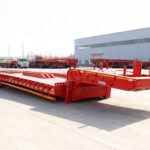
Lowbed semi trailers are specifically designed for transporting heavy and tall machinery.
Their low deck height improves stability and helps operators comply with road height restrictions. These trailers are commonly used in construction, mining, and infrastructure projects.
Lowbed trailers often include ramps or detachable gooseneck systems that allow tracked equipment to drive directly onto the trailer platform.
Common Lowbed Applications
- Excavators
- Bulldozers
- Cranes
- Construction equipment
- Mining machinery
Main Advantages
- Improved stability
- Better height compliance
- Efficient heavy equipment loading
Refrigerated Semi Trailer
Refrigerated semi trailers are essential in cold chain transportation.
These trailers use integrated refrigeration systems to maintain controlled temperatures during transport. They are widely used in food logistics, pharmaceutical transportation, and temperature-sensitive supply chains.
Temperature consistency is critical for protecting cargo quality during long-distance transportation.
Common Refrigerated Cargo
| Cargo Type | Temperature Requirement | Industry |
|---|---|---|
| Frozen food | Below 0°C | Food logistics |
| Fresh produce | 2–8°C | Agriculture |
| Pharmaceuticals | Controlled range | Medical transport |
| Dairy products | Cold storage | Food distribution |
Main Advantages
- Temperature control
- Cargo preservation
- Long-distance cold chain capability
Tank Semi Trailer
Tank semi trailers are designed for transporting liquid cargo such as fuel, chemicals, and industrial fluids.
These trailers use sealed tank structures to improve cargo safety and reduce leakage risks.
Tank trailers vary depending on liquid type, transport pressure requirements, and safety regulations.
Common Tank Trailer Applications
- Fuel transportation
- Chemical logistics
- Industrial liquids
- Food-grade liquid transport
Main Advantages
- Leak prevention
- Specialized cargo safety
- High-volume liquid transport
Stake-Side Semi Trailer
Stake-side semi trailers combine an open structure with removable side panels.
They are commonly used for transporting bulk cargo, agricultural products, and building materials. Their flexible side structure allows easier loading and unloading compared to enclosed trailers.
Common Applications
- Agricultural cargo
- Construction materials
- Bulk freight
- Regional logistics
Main Advantages
- Flexible cargo handling
- Easy side loading
- Versatile transport capability
Curtain Side Semi Trailer
Curtain side trailers use retractable side curtains instead of fixed walls.
This design improves loading efficiency because forklifts can access cargo from the sides quickly. Curtain side trailers are widely used in palletized freight transport.
Main Advantages
- Faster loading operations
- Improved cargo accessibility
- Better weather protection than flatbeds
Heavy Haul Trailer
Heavy haul trailers are designed for transporting oversized and overweight cargo.
These trailers use reinforced chassis structures, multiple axle lines, and advanced suspension systems to distribute extreme loads safely.
Heavy haul trailers are essential in infrastructure, mining, and industrial projects.
Common Heavy Haul Cargo
| Cargo Type | Industry | Transport Challenge |
|---|---|---|
| Transformers | Energy | Extreme weight |
| Turbines | Power generation | Oversized dimensions |
| Mining equipment | Mining | Structural load stress |
| Industrial modules | Infrastructure | Multi-axle distribution |
Main Advantages
- Extreme load capacity
- Improved load distribution
- Oversized cargo transport capability

Semi Trailer Axle Configurations
Axle configuration is one of the most important considerations when selecting semi trailer types.
Different axle numbers affect:
- Payload capacity
- Stability
- Fuel efficiency
- Compliance with transport regulations
Common Configurations
| Axle Setup | Typical Use |
|---|---|
| 2-axle | Light freight |
| 3-axle | Standard logistics |
| 4-axle | Heavy cargo |
| Multi axle | Oversized transport |
Choosing the correct axle configuration improves operational performance and road compliance.
How to Choose the Right Semi Trailer Type
Businesses should evaluate several factors before selecting a trailer type.
Cargo Characteristics
Cargo size, weight, and transport conditions determine the required trailer structure.
Road Conditions
Rough roads may require reinforced suspension systems and stronger chassis structures.
Transport Distance
Long-distance operations require fuel-efficient and durable trailer systems.
Regulatory Compliance
Different countries have different regulations regarding dimensions and axle loads.
Maintenance Requirements
Operators should consider spare parts availability and long-term maintenance costs.
Technology Trends in Semi Trailer Manufacturing
Modern trailer manufacturing is evolving rapidly.
Lightweight Engineering
Manufacturers increasingly use high-strength steel to reduce trailer weight while maintaining durability.
Smart Monitoring Systems
Digital fleet management systems help operators monitor trailer conditions in real time.
Automated Manufacturing
Robotic welding and laser cutting improve production precision and structural consistency.
Customization Trends
Businesses increasingly require specialized trailer solutions designed for specific transport tasks.
These trends are reshaping the future of semi trailer transportation.
Common Mistakes When Choosing Semi Trailer Types
Many buyers focus only on purchase cost rather than operational efficiency.
Common mistakes include:
- Choosing insufficient payload capacity
- Ignoring road conditions
- Selecting incorrect axle configurations
- Overlooking regulatory requirements
- Underestimating maintenance needs
Proper planning helps businesses avoid long-term operational problems.
FAQ
What are the most common semi trailer types?
The most common semi-trailer types include flatbed trailers, lowbed trailers, refrigerated trailers, tank trailers, and heavy haul trailers.
Which semi-trailer type is best for heavy machinery?
Lowbed and heavy haul trailers are best suited for transporting heavy machinery.
Why are refrigerated trailers important?
Refrigerated trailers maintain controlled temperatures for food, pharmaceuticals, and temperature-sensitive cargo.
What affects trailer selection the most?
Cargo weight, dimensions, transport distance, and road conditions are the main factors affecting trailer selection.
Can semi-trailers be customized?
Yes. Modern trailer manufacturers provide customized solutions based on industry and cargo requirements.
Conclusion
Understanding semi trailer types is essential for businesses involved in logistics, construction, industrial transport, and heavy haul operations.
Different trailer structures are designed to solve different transport challenges. Choosing the correct trailer improves safety, efficiency, and long-term operational performance.
As transportation industries continue evolving, businesses increasingly require flexible, durable, and specialized trailer solutions that support modern logistics demands.
Contact Yufei for Customized Semi Trailer Solutions
Yufei provides customized trailer solutions for logistics, heavy equipment transport, industrial cargo, and specialized applications. The company focuses on intelligent manufacturing, lightweight engineering, and customized transport systems for global markets.

Blog Categories
Contact Us
Latest News
-
Semi Trailer Export Documentation Checklist for Overseas Buyers
-

Bulk Powder Tanker Air Compressor Matching Guide
-

Yufei Customization: Reconstructing Transport Value
-

Side Curtain Trailer Loading Access Guide for Pallet Freight
-

Semi Trailer After-Sales Support Checklist for Importers
-
Bulk Powder Tanker Loading Plan for Cleaner Dry Bulk Dispatch
-
Semi Trailer Pre-Delivery Inspection Checklist for Overseas Buyers
-
Semi Trailer Fleet Inspection Calendar for Monthly Maintenance Planning
-

Yufei Heavy-duty Trailer Launched, Technology Empowers
-
Multi Axle Trailer Guide for Heavy Equipment Transport
-
Semi Trailer Brake Air Line Routing Guide for Fleet Reliability
-

Refrigerated Semi Trailer Door Seal Inspection for Cold Chain Loads
-

Heavy Haul Trailer Guide: Types, Specs & Buying Tips
-
Refrigerated Semi Trailer Loading Checklist for Cold Chain Dispatch
-

Stake Side Semi Trailer Side Board Inspection for Mixed Cargo
-
Special Purpose Trailer Maintenance Schedule for Fleet Reliability
-

Container Chassis Selection Guide for Port and Inland Freight
-
Semi Trailer Shipping Protection Guide for Overseas Buyers
-
Container Chassis Inspection Checklist Before Port Dispatch
View our industry solutions
Or learn about other industry content
Choosing the right semi trailer is not simply about selecting a transport vehicle. Different industries require different trailer structures, load capacities, and transport configurations. Understanding semi trailer types helps logistics companies, construction contractors, and freight operators improve efficiency while reducing operational costs.
Modern transportation demands continue to evolve as industries require more specialized cargo solutions. From construction machinery and containers to refrigerated products and oversized industrial equipment, each transport task requires a specific trailer design.
For businesses entering the transportation or heavy logistics industry, understanding semi trailer types is essential for improving fleet planning and maximizing long-term operational value.
Table of Contents
Why Understanding Semi Trailer Types Matters
Different cargo creates different transport challenges. A trailer designed for refrigerated food transport cannot efficiently handle heavy machinery, while a lowbed trailer designed for construction equipment would not be suitable for liquid cargo.
Selecting the correct semi trailer type improves:
- Cargo safety
- Fuel efficiency
- Transport stability
- Loading efficiency
- Compliance with transport regulations
Understanding semi trailer types also helps businesses avoid unnecessary maintenance costs and improve fleet utilization.
Flatbed Semi Trailer
Flatbed semi trailers are among the most widely used trailer types in global logistics operations.
Their open platform structure allows loading from the rear, sides, or top, making them highly versatile for transporting containers, steel products, construction materials, and industrial cargo.
Flatbed semi trailers are especially popular in freight transportation because they simplify loading and unloading operations.
Common Flatbed Applications
- Steel transport
- Container logistics
- Building materials
- Industrial machinery
- Oversized freight
Main Advantages
- Flexible loading options
- Lower maintenance complexity
- Broad cargo compatibility
Lowbed Semi Trailer
Lowbed semi trailers are specifically designed for transporting heavy and tall machinery.
Their low deck height improves stability and helps operators comply with road height restrictions. These trailers are commonly used in construction, mining, and infrastructure projects.
Lowbed trailers often include ramps or detachable gooseneck systems that allow tracked equipment to drive directly onto the trailer platform.
Common Lowbed Applications
- Excavators
- Bulldozers
- Cranes
- Construction equipment
- Mining machinery
Main Advantages
- Improved stability
- Better height compliance
- Efficient heavy equipment loading
Refrigerated Semi Trailer
Refrigerated semi trailers are essential in cold chain transportation.
These trailers use integrated refrigeration systems to maintain controlled temperatures during transport. They are widely used in food logistics, pharmaceutical transportation, and temperature-sensitive supply chains.
Temperature consistency is critical for protecting cargo quality during long-distance transportation.
Common Refrigerated Cargo
| Cargo Type | Temperature Requirement | Industry |
|---|---|---|
| Frozen food | Below 0°C | Food logistics |
| Fresh produce | 2–8°C | Agriculture |
| Pharmaceuticals | Controlled range | Medical transport |
| Dairy products | Cold storage | Food distribution |
Main Advantages
- Temperature control
- Cargo preservation
- Long-distance cold chain capability
Tank Semi Trailer
Tank semi trailers are designed for transporting liquid cargo such as fuel, chemicals, and industrial fluids.
These trailers use sealed tank structures to improve cargo safety and reduce leakage risks.
Tank trailers vary depending on liquid type, transport pressure requirements, and safety regulations.
Common Tank Trailer Applications
- Fuel transportation
- Chemical logistics
- Industrial liquids
- Food-grade liquid transport
Main Advantages
- Leak prevention
- Specialized cargo safety
- High-volume liquid transport
Stake-Side Semi Trailer
Stake-side semi trailers combine an open structure with removable side panels.
They are commonly used for transporting bulk cargo, agricultural products, and building materials. Their flexible side structure allows easier loading and unloading compared to enclosed trailers.
Common Applications
- Agricultural cargo
- Construction materials
- Bulk freight
- Regional logistics
Main Advantages
- Flexible cargo handling
- Easy side loading
- Versatile transport capability
Curtain Side Semi Trailer
Curtain side trailers use retractable side curtains instead of fixed walls.
This design improves loading efficiency because forklifts can access cargo from the sides quickly. Curtain side trailers are widely used in palletized freight transport.
Main Advantages
- Faster loading operations
- Improved cargo accessibility
- Better weather protection than flatbeds
Heavy Haul Trailer
Heavy haul trailers are designed for transporting oversized and overweight cargo.
These trailers use reinforced chassis structures, multiple axle lines, and advanced suspension systems to distribute extreme loads safely.
Heavy haul trailers are essential in infrastructure, mining, and industrial projects.
Common Heavy Haul Cargo
| Cargo Type | Industry | Transport Challenge |
|---|---|---|
| Transformers | Energy | Extreme weight |
| Turbines | Power generation | Oversized dimensions |
| Mining equipment | Mining | Structural load stress |
| Industrial modules | Infrastructure | Multi-axle distribution |
Main Advantages
- Extreme load capacity
- Improved load distribution
- Oversized cargo transport capability
Semi Trailer Axle Configurations
Axle configuration is one of the most important considerations when selecting semi trailer types.
Different axle numbers affect:
- Payload capacity
- Stability
- Fuel efficiency
- Compliance with transport regulations
Common Configurations
| Axle Setup | Typical Use |
|---|---|
| 2-axle | Light freight |
| 3-axle | Standard logistics |
| 4-axle | Heavy cargo |
| Multi axle | Oversized transport |
Choosing the correct axle configuration improves operational performance and road compliance.
How to Choose the Right Semi Trailer Type
Businesses should evaluate several factors before selecting a trailer type.
Cargo Characteristics
Cargo size, weight, and transport conditions determine the required trailer structure.
Road Conditions
Rough roads may require reinforced suspension systems and stronger chassis structures.
Transport Distance
Long-distance operations require fuel-efficient and durable trailer systems.
Regulatory Compliance
Different countries have different regulations regarding dimensions and axle loads.
Maintenance Requirements
Operators should consider spare parts availability and long-term maintenance costs.
Technology Trends in Semi Trailer Manufacturing
Modern trailer manufacturing is evolving rapidly.
Lightweight Engineering
Manufacturers increasingly use high-strength steel to reduce trailer weight while maintaining durability.
Smart Monitoring Systems
Digital fleet management systems help operators monitor trailer conditions in real time.
Automated Manufacturing
Robotic welding and laser cutting improve production precision and structural consistency.
Customization Trends
Businesses increasingly require specialized trailer solutions designed for specific transport tasks.
These trends are reshaping the future of semi trailer transportation.
Common Mistakes When Choosing Semi Trailer Types
Many buyers focus only on purchase cost rather than operational efficiency.
Common mistakes include:
- Choosing insufficient payload capacity
- Ignoring road conditions
- Selecting incorrect axle configurations
- Overlooking regulatory requirements
- Underestimating maintenance needs
Proper planning helps businesses avoid long-term operational problems.
FAQ
What are the most common semi trailer types?
The most common semi-trailer types include flatbed trailers, lowbed trailers, refrigerated trailers, tank trailers, and heavy haul trailers.
Which semi-trailer type is best for heavy machinery?
Lowbed and heavy haul trailers are best suited for transporting heavy machinery.
Why are refrigerated trailers important?
Refrigerated trailers maintain controlled temperatures for food, pharmaceuticals, and temperature-sensitive cargo.
What affects trailer selection the most?
Cargo weight, dimensions, transport distance, and road conditions are the main factors affecting trailer selection.
Can semi-trailers be customized?
Yes. Modern trailer manufacturers provide customized solutions based on industry and cargo requirements.
Conclusion
Understanding semi trailer types is essential for businesses involved in logistics, construction, industrial transport, and heavy haul operations.
Different trailer structures are designed to solve different transport challenges. Choosing the correct trailer improves safety, efficiency, and long-term operational performance.
As transportation industries continue evolving, businesses increasingly require flexible, durable, and specialized trailer solutions that support modern logistics demands.
Contact Yufei for Customized Semi Trailer Solutions
Yufei provides customized trailer solutions for logistics, heavy equipment transport, industrial cargo, and specialized applications. The company focuses on intelligent manufacturing, lightweight engineering, and customized transport systems for global markets.
Blog Categories
Contact Us
Latest News
-
Yufei Customization: Reconstructing Transport Value
-

E-commerce peak season: Yufei stake trailer, double the efficiency.
-
Container Chassis Selection Guide for Port and Inland Freight
-
Duplicate Draft – Special Purpose Trailer Maintenance Schedule
-
Lowboy Trailer Ramp Angle Planning for Construction Machinery
-
Semi Trailer Spare Parts Planning for Fleet Maintenance Teams
-

Tanker Semi Trailer Baffle Planning for Liquid Cargo Stability
-
Bulk Powder Tanker Air Line Inspection Before Dry Bulk Loading
-

Semi Trailer Coupling Height Guide for Safer Tractor Matching
-
Semi Trailer Fleet Inspection Calendar for Monthly Maintenance Planning
-

Semi Trailer Load Distribution Guide for Safer Heavy Cargo Transport
-
Hydraulic Semi-Trailers in 2026: Navigating the Evolving Landscape
-
How to Choose Semi Trailer Solutions for Different Regions and Road Conditions
-
Semi Trailer Export Documentation Checklist for Overseas Buyers
-
Container Chassis Twist Lock Inspection Guide for Port Fleets
-
Heavy Haul Trailers: How to Choose the Right One
-
Semi Trailer Import Checklist for Overseas Fleet Buyers
-
Customized Semi Trailer Solutions & Special Purpose Vehicles for Modern Transportation
-
Refrigerated Semi Trailer Door Seal Inspection for Cold Chain Loads
View our industry solutions
Or learn about other industry content
Engineering Equipment Transportation:
Custom Trailers Provide Efficient Solutions
Yufei solves the pain points of engineering equipment transportation for a Henan equipment leasing company:
Customer Pain Points:
Insufficient carrying capacity for 35-ton excavators, delays due to poor turning capabilities on narrow construction site roads, and trailer delivery times exceeding 45 days.
Solution:
Customized 80-ton low-bed trailers with 1.2-meter cargo platforms and hydraulic steering, with flexible production lines for expedited delivery.

Hazardous Materials Transportation:
Class A Tank Trucks Enhance Safety and Increase Profits
Yufei solved a core challenge for its logistics partner, Sinopec, in the transportation of hazardous materials:
Customer Pain Points:
Old tank trucks have significant leak risks, a 12-ton self-weight limits cargo capacity, and fuel consumption exceeds 35L.
Solution:
The Class A tanker has 304 stainless tank, triple safety devices and lightweight 0690 structure.

General Logistics:
Stake Trailer Solves Transportation Capacity Challenges
Yufei helps a Shandong logistics company overcome transportation pain points during peak e-commerce seasons:
Customer Pain Points:
Old trailers have slow loading and unloading times, limited capacity for bulky goods, fuel consumption exceeds 32L, and insufficient transportation capacity during peak seasons.
Solution:
Customizable foldable stake trailers, lightweight Q690 steel construction + hydraulic self-unloading.

[Customer Case Studies]
Yufei's customized solutions
Based in Liangshan, Yufei has been specializing in special purpose/semi-trailers since 2008, with real-world service cases worldwide demonstrating its intelligent manufacturing capabilities.
[Customer Case Studies]
Yufei's customized solutions
Based in Liangshan, Yufei has been specializing in special purpose/semi-trailers since 2008, with real-world service cases worldwide demonstrating its intelligent manufacturing capabilities.
Engineering Equipment Transportation:
Custom Trailers Provide Efficient Solutions
Yufei solves the pain points of engineering equipment transportation for a Henan equipment leasing company:
Customer Pain Points:
Insufficient carrying capacity for 35-ton excavators, delays due to poor turning capabilities on narrow construction site roads, and trailer delivery times exceeding 45 days.
Solution:
Customized 80-ton low-bed trailers with 1.2-meter cargo platforms and hydraulic steering, with flexible production lines for expedited delivery.
Hazardous Materials Transportation:
Class A Tank Trucks Enhance Safety and Increase Profits
Yufei solved a core challenge for its logistics partner, Sinopec, in the transportation of hazardous materials:
Customer Pain Points:
Old tank trucks have significant leak risks, a 12-ton self-weight limits cargo capacity, and fuel consumption exceeds 35L.
Solution:
The Class A tanker has 304 stainless tank, triple safety devices and lightweight 0690 structure.
General Logistics:
Stake Trailer Solves Transportation Capacity Challenges
Yufei helps a Shandong logistics company overcome transportation pain points during peak e-commerce seasons:
Customer Pain Points:
Old trailers have slow loading and unloading times, limited capacity for bulky goods, fuel consumption exceeds 32L, and insufficient transportation capacity during peak seasons.
Solution:
Customizable foldable stake trailers, lightweight Q690 steel construction + hydraulic self-unloading.
[Core advantages]
Core Competitiveness
Driven by Intelligence & Service
Strong
R&D Team:
120-member team, 45% senior titles, leading tech

Intelligent
Manufacturing:
Robotic welding, 99%+ precision guarantee

Rapid
Customization:
Flexible lines for diverse needs, 7-day delivery

Strict
Quality Control:
Full-process control, ISO9001 certified

Comprehensive
After-sales:
24h response, lifelong operation support

Industrial
Cluster Adv:
Liangshan base, efficient supply chain

Lightweight
Tech Breakthrough:
Topology optimization, 18% weight reduction

Complete
Qualifications:
CCC certified, Class A for hazardous goods

[Contact us]
Ready to Find Your
Perfect Trailer Solution







