
Semi Trailer Types Explained for Different Transport Industries
Semi Trailer Types Explained for Different Transport Industries

Choosing the right semi trailer is not simply about selecting a transport vehicle. Different industries require different trailer structures, load capacities, and transport configurations. Understanding semi trailer types helps logistics companies, construction contractors, and freight operators improve efficiency while reducing operational costs.
Modern transportation demands continue to evolve as industries require more specialized cargo solutions. From construction machinery and containers to refrigerated products and oversized industrial equipment, each transport task requires a specific trailer design.
For businesses entering the transportation or heavy logistics industry, understanding semi trailer types is essential for improving fleet planning and maximizing long-term operational value.
Índice
Why Understanding Semi Trailer Types Matters
Different cargo creates different transport challenges. A trailer designed for refrigerated food transport cannot efficiently handle heavy machinery, while a lowbed trailer designed for construction equipment would not be suitable for liquid cargo.
Selecting the correct semi trailer type improves:
- Cargo safety
- Fuel efficiency
- Transport stability
- Loading efficiency
- Compliance with transport regulations
Understanding semi trailer types also helps businesses avoid unnecessary maintenance costs and improve fleet utilization.
Semirremolque de plataforma
Flatbed semi trailers are among the most widely used trailer types in global logistics operations.
Their open platform structure allows loading from the rear, sides, or top, making them highly versatile for transporting containers, steel products, construction materials, and industrial cargo.
Flatbed semi trailers are especially popular in freight transportation because they simplify loading and unloading operations.
Common Flatbed Applications
- Steel transport
- Container logistics
- Building materials
- Industrial machinery
- Oversized freight
Main Advantages
- Flexible loading options
- Lower maintenance complexity
- Broad cargo compatibility
Lowbed Semi Trailer
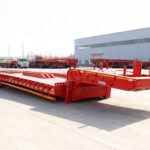
Lowbed semi trailers are specifically designed for transporting heavy and tall machinery.
Their low deck height improves stability and helps operators comply with road height restrictions. These trailers are commonly used in construction, mining, and infrastructure projects.
Lowbed trailers often include ramps or detachable gooseneck systems that allow tracked equipment to drive directly onto the trailer platform.
Common Lowbed Applications
- Excavators
- Bulldozers
- Cranes
- Construction equipment
- Mining machinery
Main Advantages
- Improved stability
- Better height compliance
- Efficient heavy equipment loading
Refrigerated Semi Trailer
Refrigerated semi trailers are essential in cold chain transportation.
These trailers use integrated refrigeration systems to maintain controlled temperatures during transport. They are widely used in food logistics, pharmaceutical transportation, and temperature-sensitive supply chains.
Temperature consistency is critical for protecting cargo quality during long-distance transportation.
Common Refrigerated Cargo
| Tipo de carga | Temperature Requirement | Industria |
|---|---|---|
| Frozen food | Below 0°C | Food logistics |
| Fresh produce | 2–8°C | Agricultura |
| Pharmaceuticals | Controlled range | Medical transport |
| Dairy products | Cold storage | Food distribution |
Main Advantages
- Temperature control
- Cargo preservation
- Long-distance cold chain capability
Tank Semi Trailer
Tank semi trailers are designed for transporting liquid cargo such as fuel, chemicals, and industrial fluids.
These trailers use sealed tank structures to improve cargo safety and reduce leakage risks.
Tank trailers vary depending on liquid type, transport pressure requirements, and safety regulations.
Common Tank Trailer Applications
- Fuel transportation
- Chemical logistics
- Industrial liquids
- Food-grade liquid transport
Main Advantages
- Leak prevention
- Specialized cargo safety
- High-volume liquid transport
Stake-Side Semi Trailer
Stake-side semi trailers combine an open structure with removable side panels.
They are commonly used for transporting bulk cargo, agricultural products, and building materials. Their flexible side structure allows easier loading and unloading compared to enclosed trailers.
Common Applications
- Agricultural cargo
- Construction materials
- Bulk freight
- Regional logistics
Main Advantages
- Manipulación flexible de la carga
- Easy side loading
- Versatile transport capability
Curtain Side Semi Trailer
Curtain side trailers use retractable side curtains instead of fixed walls.
This design improves loading efficiency because forklifts can access cargo from the sides quickly. Curtain side trailers are widely used in palletized freight transport.
Main Advantages
- Faster loading operations
- Improved cargo accessibility
- Better weather protection than flatbeds
Heavy Haul Trailer
Heavy haul trailers are designed for transporting oversized and overweight cargo.
These trailers use reinforced chassis structures, multiple axle lines, and advanced suspension systems to distribute extreme loads safely.
Heavy haul trailers are essential in infrastructure, mining, and industrial projects.
Common Heavy Haul Cargo
| Tipo de carga | Industria | Desafío del transporte |
|---|---|---|
| Transformers | Energy | Extreme weight |
| Turbines | Power generation | Oversized dimensions |
| Equipos de minería | Minería | Structural load stress |
| Industrial modules | Infrastructure | Multi-axle distribution |
Main Advantages
- Extreme load capacity
- Improved load distribution
- Oversized cargo transport capability

Semi Trailer Axle Configurations
Axle configuration is one of the most important considerations when selecting semi trailer types.
Different axle numbers affect:
- Payload capacity
- Stability
- Fuel efficiency
- Compliance with transport regulations
Common Configurations
| Axle Setup | Typical Use |
|---|---|
| 2-axle | Light freight |
| 3-axle | Standard logistics |
| 4-axle | Heavy cargo |
| Multi axle | Oversized transport |
Choosing the correct axle configuration improves operational performance and road compliance.
How to Choose the Right Semi Trailer Type
Businesses should evaluate several factors before selecting a trailer type.
Cargo Characteristics
Cargo size, weight, and transport conditions determine the required trailer structure.
Road Conditions
Rough roads may require reinforced suspension systems and stronger chassis structures.
Transport Distance
Long-distance operations require fuel-efficient and durable trailer systems.
Regulatory Compliance
Different countries have different regulations regarding dimensions and axle loads.
Maintenance Requirements
Operators should consider spare parts availability and long-term maintenance costs.
Technology Trends in Semi Trailer Manufacturing
Modern trailer manufacturing is evolving rapidly.
Lightweight Engineering
Manufacturers increasingly use high-strength steel to reduce trailer weight while maintaining durability.
Smart Monitoring Systems
Digital fleet management systems help operators monitor trailer conditions in real time.
Automated Manufacturing
Robotic welding and laser cutting improve production precision and structural consistency.
Customization Trends
Businesses increasingly require specialized trailer solutions designed for specific transport tasks.
These trends are reshaping the future of semi trailer transportation.
Common Mistakes When Choosing Semi Trailer Types
Many buyers focus only on purchase cost rather than operational efficiency.
Common mistakes include:
- Choosing insufficient payload capacity
- Ignoring road conditions
- Selecting incorrect axle configurations
- Overlooking regulatory requirements
- Underestimating maintenance needs
Proper planning helps businesses avoid long-term operational problems.
PREGUNTAS FRECUENTES
What are the most common semi trailer types?
The most common semi-trailer types include flatbed trailers, lowbed trailers, refrigerated trailers, tank trailers, and heavy haul trailers.
Which semi-trailer type is best for heavy machinery?
Lowbed and heavy haul trailers are best suited for transporting heavy machinery.
Why are refrigerated trailers important?
Refrigerated trailers maintain controlled temperatures for food, pharmaceuticals, and temperature-sensitive cargo.
What affects trailer selection the most?
Cargo weight, dimensions, transport distance, and road conditions are the main factors affecting trailer selection.
Can semi-trailers be customized?
Yes. Modern trailer manufacturers provide customized solutions based on industry and cargo requirements.
Conclusión
Understanding semi trailer types is essential for businesses involved in logistics, construction, industrial transport, and heavy haul operations.
Different trailer structures are designed to solve different transport challenges. Choosing the correct trailer improves safety, efficiency, and long-term operational performance.
As transportation industries continue evolving, businesses increasingly require flexible, durable, and specialized trailer solutions that support modern logistics demands.
Contact Yufei for Customized Semi Trailer Solutions
Yufei provides customized trailer solutions for logistics, heavy equipment transport, industrial cargo, and specialized applications. The company focuses on intelligent manufacturing, lightweight engineering, and customized transport systems for global markets.

Categorías de blogs
Contacte con nosotros
Últimas noticias
-

Semi Trailer Frame Inspection Guide for Heavy-Duty Buyers
-

Rear Dump Trailer Stability Checklist Before Unloading Loose Material
-

Aplicaciones de Remolques de Cama Baja para el Transporte de Equipos Pesados
-

Tanker Semi Trailer Cleaning Preparation Before Cargo Changeover
-
Lowbed Trailer Hydraulic Ramp Guide for Equipment Loading
-

Camiones semirremolque: Cómo elegir el adecuado para su negocio
-
Dump Semi Trailer Hydraulic Cylinder Checks Before Site Work
-

Duplicate Draft – Special Purpose Trailer Maintenance Schedule
-

Heavy Haul Trailer Guide: Types, Specs & Buying Tips
-

Tanker Trailer Unloading Hose Guide for Fleet Operators
-
Lowboy Trailer Tire Clearance Guide for Heavy Equipment Loads
-
Soluciones personalizadas de semirremolques y vehículos especiales para el transporte moderno
-
Lowbed Trailer Route Survey Checklist for Heavy Equipment Moves
-
Semi Trailer Wheel Bearing Inspection Guide for Long-Distance Fleets
-

Bulk Powder Tanker Air Line Inspection Before Dry Bulk Loading
-
Semi Trailer Suspension Inspection Guide for Rough Road Operations
-

How to Choose a Reliable Semi Trailer Manufacturer for Your Business
Vea nuestras soluciones sectoriales
O infórmese sobre otros contenidos del sector
Choosing the right semi trailer is not simply about selecting a transport vehicle. Different industries require different trailer structures, load capacities, and transport configurations. Understanding semi trailer types helps logistics companies, construction contractors, and freight operators improve efficiency while reducing operational costs.
Modern transportation demands continue to evolve as industries require more specialized cargo solutions. From construction machinery and containers to refrigerated products and oversized industrial equipment, each transport task requires a specific trailer design.
For businesses entering the transportation or heavy logistics industry, understanding semi trailer types is essential for improving fleet planning and maximizing long-term operational value.
Índice
Why Understanding Semi Trailer Types Matters
Different cargo creates different transport challenges. A trailer designed for refrigerated food transport cannot efficiently handle heavy machinery, while a lowbed trailer designed for construction equipment would not be suitable for liquid cargo.
Selecting the correct semi trailer type improves:
- Cargo safety
- Fuel efficiency
- Transport stability
- Loading efficiency
- Compliance with transport regulations
Understanding semi trailer types also helps businesses avoid unnecessary maintenance costs and improve fleet utilization.
Semirremolque de plataforma
Flatbed semi trailers are among the most widely used trailer types in global logistics operations.
Their open platform structure allows loading from the rear, sides, or top, making them highly versatile for transporting containers, steel products, construction materials, and industrial cargo.
Flatbed semi trailers are especially popular in freight transportation because they simplify loading and unloading operations.
Common Flatbed Applications
- Steel transport
- Container logistics
- Building materials
- Industrial machinery
- Oversized freight
Main Advantages
- Flexible loading options
- Lower maintenance complexity
- Broad cargo compatibility
Lowbed Semi Trailer
Lowbed semi trailers are specifically designed for transporting heavy and tall machinery.
Their low deck height improves stability and helps operators comply with road height restrictions. These trailers are commonly used in construction, mining, and infrastructure projects.
Lowbed trailers often include ramps or detachable gooseneck systems that allow tracked equipment to drive directly onto the trailer platform.
Common Lowbed Applications
- Excavators
- Bulldozers
- Cranes
- Construction equipment
- Mining machinery
Main Advantages
- Improved stability
- Better height compliance
- Efficient heavy equipment loading
Refrigerated Semi Trailer
Refrigerated semi trailers are essential in cold chain transportation.
These trailers use integrated refrigeration systems to maintain controlled temperatures during transport. They are widely used in food logistics, pharmaceutical transportation, and temperature-sensitive supply chains.
Temperature consistency is critical for protecting cargo quality during long-distance transportation.
Common Refrigerated Cargo
| Tipo de carga | Temperature Requirement | Industria |
|---|---|---|
| Frozen food | Below 0°C | Food logistics |
| Fresh produce | 2–8°C | Agricultura |
| Pharmaceuticals | Controlled range | Medical transport |
| Dairy products | Cold storage | Food distribution |
Main Advantages
- Temperature control
- Cargo preservation
- Long-distance cold chain capability
Tank Semi Trailer
Tank semi trailers are designed for transporting liquid cargo such as fuel, chemicals, and industrial fluids.
These trailers use sealed tank structures to improve cargo safety and reduce leakage risks.
Tank trailers vary depending on liquid type, transport pressure requirements, and safety regulations.
Common Tank Trailer Applications
- Fuel transportation
- Chemical logistics
- Industrial liquids
- Food-grade liquid transport
Main Advantages
- Leak prevention
- Specialized cargo safety
- High-volume liquid transport
Stake-Side Semi Trailer
Stake-side semi trailers combine an open structure with removable side panels.
They are commonly used for transporting bulk cargo, agricultural products, and building materials. Their flexible side structure allows easier loading and unloading compared to enclosed trailers.
Common Applications
- Agricultural cargo
- Construction materials
- Bulk freight
- Regional logistics
Main Advantages
- Manipulación flexible de la carga
- Easy side loading
- Versatile transport capability
Curtain Side Semi Trailer
Curtain side trailers use retractable side curtains instead of fixed walls.
This design improves loading efficiency because forklifts can access cargo from the sides quickly. Curtain side trailers are widely used in palletized freight transport.
Main Advantages
- Faster loading operations
- Improved cargo accessibility
- Better weather protection than flatbeds
Heavy Haul Trailer
Heavy haul trailers are designed for transporting oversized and overweight cargo.
These trailers use reinforced chassis structures, multiple axle lines, and advanced suspension systems to distribute extreme loads safely.
Heavy haul trailers are essential in infrastructure, mining, and industrial projects.
Common Heavy Haul Cargo
| Tipo de carga | Industria | Desafío del transporte |
|---|---|---|
| Transformers | Energy | Extreme weight |
| Turbines | Power generation | Oversized dimensions |
| Equipos de minería | Minería | Structural load stress |
| Industrial modules | Infrastructure | Multi-axle distribution |
Main Advantages
- Extreme load capacity
- Improved load distribution
- Oversized cargo transport capability
Semi Trailer Axle Configurations
Axle configuration is one of the most important considerations when selecting semi trailer types.
Different axle numbers affect:
- Payload capacity
- Stability
- Fuel efficiency
- Compliance with transport regulations
Common Configurations
| Axle Setup | Typical Use |
|---|---|
| 2-axle | Light freight |
| 3-axle | Standard logistics |
| 4-axle | Heavy cargo |
| Multi axle | Oversized transport |
Choosing the correct axle configuration improves operational performance and road compliance.
How to Choose the Right Semi Trailer Type
Businesses should evaluate several factors before selecting a trailer type.
Cargo Characteristics
Cargo size, weight, and transport conditions determine the required trailer structure.
Road Conditions
Rough roads may require reinforced suspension systems and stronger chassis structures.
Transport Distance
Long-distance operations require fuel-efficient and durable trailer systems.
Regulatory Compliance
Different countries have different regulations regarding dimensions and axle loads.
Maintenance Requirements
Operators should consider spare parts availability and long-term maintenance costs.
Technology Trends in Semi Trailer Manufacturing
Modern trailer manufacturing is evolving rapidly.
Lightweight Engineering
Manufacturers increasingly use high-strength steel to reduce trailer weight while maintaining durability.
Smart Monitoring Systems
Digital fleet management systems help operators monitor trailer conditions in real time.
Automated Manufacturing
Robotic welding and laser cutting improve production precision and structural consistency.
Customization Trends
Businesses increasingly require specialized trailer solutions designed for specific transport tasks.
These trends are reshaping the future of semi trailer transportation.
Common Mistakes When Choosing Semi Trailer Types
Many buyers focus only on purchase cost rather than operational efficiency.
Common mistakes include:
- Choosing insufficient payload capacity
- Ignoring road conditions
- Selecting incorrect axle configurations
- Overlooking regulatory requirements
- Underestimating maintenance needs
Proper planning helps businesses avoid long-term operational problems.
PREGUNTAS FRECUENTES
What are the most common semi trailer types?
The most common semi-trailer types include flatbed trailers, lowbed trailers, refrigerated trailers, tank trailers, and heavy haul trailers.
Which semi-trailer type is best for heavy machinery?
Lowbed and heavy haul trailers are best suited for transporting heavy machinery.
Why are refrigerated trailers important?
Refrigerated trailers maintain controlled temperatures for food, pharmaceuticals, and temperature-sensitive cargo.
What affects trailer selection the most?
Cargo weight, dimensions, transport distance, and road conditions are the main factors affecting trailer selection.
Can semi-trailers be customized?
Yes. Modern trailer manufacturers provide customized solutions based on industry and cargo requirements.
Conclusión
Understanding semi trailer types is essential for businesses involved in logistics, construction, industrial transport, and heavy haul operations.
Different trailer structures are designed to solve different transport challenges. Choosing the correct trailer improves safety, efficiency, and long-term operational performance.
As transportation industries continue evolving, businesses increasingly require flexible, durable, and specialized trailer solutions that support modern logistics demands.
Contact Yufei for Customized Semi Trailer Solutions
Yufei provides customized trailer solutions for logistics, heavy equipment transport, industrial cargo, and specialized applications. The company focuses on intelligent manufacturing, lightweight engineering, and customized transport systems for global markets.
Categorías de blogs
Contacte con nosotros
Últimas noticias
-
Semi Trailer Coupling Height Guide for Safer Tractor Matching
-
Duplicate Draft – Special Purpose Trailer Maintenance Schedule
-
Camiones semirremolque: Cómo elegir el adecuado para su negocio
-

La colaboración en la cadena de suministro y los remolques crean un ecosistema entre la industria y el mundo académico
-
Semi Trailer Shipping Protection Guide for Overseas Buyers
-

Semi Trailer Electrical Inspection Checklist Before Fleet Dispatch
-
Semi Trailer Lighting Inspection for Night Loading and Yard Safety
-
Soluciones personalizadas de semirremolques y vehículos especiales para el transporte moderno
-
Semi Trailer Export Documentation Checklist for Overseas Buyers
-

Cargas pesadas aseguradas: Remolque de plataforma baja Yufei
-
Semi Trailer Suspension Inspection Guide for Rough Road Operations
-
Tanker Semi Trailer Cleaning Preparation Before Cargo Changeover
-
Dump Semi Trailer Hydraulic Cylinder Checks Before Site Work
-
Eficiencia y seguridad en la conducción: Semirremolques y vehículos especiales
-

Semi Trailer Suspension Selection Guide for Heavy Loads
-
Bulk Powder Tanker Air Compressor Matching Guide
-
Semirremolques hidráulicos en 2026: navegación por un panorama en evolución
Vea nuestras soluciones sectoriales
O infórmese sobre otros contenidos del sector
Equipos de ingeniería Transporte:
Los remolques a medida ofrecen soluciones eficientes
Yufei resuelve los problemas de transporte de equipos de ingeniería para una empresa de arrendamiento de equipos de Henan:
Puntos débiles de los clientes:
Capacidad de carga insuficiente para excavadoras de 35 toneladas, retrasos debidos a la escasa capacidad de giro en carreteras de obra estrechas y plazos de entrega de los remolques superiores a 45 días.
Solución:
Remolques de plataforma baja personalizados de 80 toneladas con plataformas de carga de 1,2 metros y dirección hidráulica, con líneas de producción flexibles para entregas rápidas.

Transporte de materiales peligrosos:
Los camiones cisterna de clase A mejoran la seguridad y aumentan los beneficios
Yufei resolvió un reto fundamental para su socio logístico, Sinopec, en el transporte de materiales peligrosos:
Puntos débiles de los clientes:
Los camiones cisterna antiguos presentan importantes riesgos de fuga, un peso propio de 12 toneladas limita la capacidad de carga y el consumo de combustible supera los 35 litros.
Solución:
La cisterna de clase A cuenta con un depósito de acero inoxidable 304, dispositivos de seguridad triples y una estructura ligera 0690.

Logística general:
Un remolque con estacas resuelve los problemas de capacidad de transporte
Yufei ayuda a una empresa logística de Shandong a superar los problemas de transporte durante las temporadas altas del comercio electrónico:
Puntos débiles de los clientes:
Los remolques viejos tienen tiempos de carga y descarga lentos, capacidad limitada para mercancías voluminosas, un consumo de combustible superior a 32 litros y una capacidad de transporte insuficiente durante las temporadas altas.
Solución:
Remolques de estacas plegables personalizables, construcción ligera de acero Q690 + autodescarga hidráulica.

[Casos prácticos de clientes]
Soluciones personalizadas de Yufei
Con sede en Liangshan, Yufei se ha especializado en semirremolques para usos especiales desde 2008, con casos de servicio reales en todo el mundo que demuestran su capacidad de fabricación inteligente.
[Casos prácticos de clientes]
Soluciones personalizadas de Yufei
Con sede en Liangshan, Yufei se ha especializado en semirremolques para usos especiales desde 2008, con casos de servicio reales en todo el mundo que demuestran su capacidad de fabricación inteligente.
Equipos de ingeniería Transporte:
Los remolques a medida ofrecen soluciones eficientes
Yufei resuelve los problemas de transporte de equipos de ingeniería para una empresa de arrendamiento de equipos de Henan:
Puntos débiles de los clientes:
Capacidad de carga insuficiente para excavadoras de 35 toneladas, retrasos debidos a la escasa capacidad de giro en carreteras de obra estrechas y plazos de entrega de los remolques superiores a 45 días.
Solución:
Remolques de plataforma baja personalizados de 80 toneladas con plataformas de carga de 1,2 metros y dirección hidráulica, con líneas de producción flexibles para entregas rápidas.
Transporte de materiales peligrosos:
Los camiones cisterna de clase A mejoran la seguridad y aumentan los beneficios
Yufei resolvió un reto fundamental para su socio logístico, Sinopec, en el transporte de materiales peligrosos:
Puntos débiles de los clientes:
Los camiones cisterna antiguos presentan importantes riesgos de fuga, un peso propio de 12 toneladas limita la capacidad de carga y el consumo de combustible supera los 35 litros.
Solución:
La cisterna de clase A cuenta con un depósito de acero inoxidable 304, dispositivos de seguridad triples y una estructura ligera 0690.
Logística general:
Un remolque con estacas resuelve los problemas de capacidad de transporte
Yufei ayuda a una empresa logística de Shandong a superar los problemas de transporte durante las temporadas altas del comercio electrónico:
Puntos débiles de los clientes:
Los remolques viejos tienen tiempos de carga y descarga lentos, capacidad limitada para mercancías voluminosas, un consumo de combustible superior a 32 litros y una capacidad de transporte insuficiente durante las temporadas altas.
Solución:
Remolques de estacas plegables personalizables, construcción ligera de acero Q690 + autodescarga hidráulica.
[Ventajas principales]
Competitividad básica
Impulsados por la inteligencia y el servicio
Fuerte
Equipo de I+D:
Equipo de 120 miembros, 451 títulos seniorTP3T, tecnología punta

Inteligente
Fabricación:
Soldadura robotizada, garantía de precisión 99%

Rápido
Personalización:
Líneas flexibles para necesidades diversas, entrega en 7 días

Estricto
Control de calidad:
Control total del proceso, certificación ISO9001

Completo
Postventa:
Respuesta 24 horas, asistencia operativa de por vida

Industrial
Grupo Adv:
Base de Liangshan, cadena de suministro eficiente

Ligero
Avance tecnológico:
Optimización de la topología, reducción de peso 18%

Complete
Cualificaciones:
Certificado CCC, Clase A para mercancías peligrosas

[Contáctenos]
Listo para encontrar su
Solución de remolque perfecta







