
Refrigerated Trailer Dimensions: Pallets, Doors and Airflow
Refrigerated Trailer Dimensions: Pallets, Doors and Airflow
Table des matières
For refrigerated trailer dimensions, the purchasing decision is about pallet layout and usable interior space. Start with the real operating case and require evidence for the interfaces that determine whether the equipment will fit the work. This guide connects refrigerated trailer dimensions with the information a fleet buyer can request, compare and retain before approving a configuration.
Define the job for refrigerated trailer dimensions
A pallet layout can pass a simple length-and-width calculation and still fail at the rear opening. The buying task is to establish a usable envelope that includes insulation, obstructions and circulation space. Begin with the largest routine pallet and the narrowest passage it must cross. Keep the forklift approach, packaging overhang and door clearance on the same drawing. The useful outcome is an approved arrangement that loaders can repeat, with a clear rule for reviewing a new package size.
Turn the buying question into acceptance evidence
First, establish pallet footprint. Request actual wrapped package measurements and draw the largest routine arrangement.
Next, resolve rear opening. Request clear door dimensions and loading approach and check passage before counting positions.
Then, review air path. Request supplier loading-clearance drawing and reserve supply and return space.
Finally, document final body. Request approved fitted interior revision and repeat layout after panel or partition changes.
For refrigerated trailer dimensions, these four items define the technical comparison. Keep each answer linked to the same operating case and final configuration. Record missing evidence explicitly, so the receiving team can distinguish an agreed requirement from an unresolved assumption.
Separate the cargo envelope from the outside box for refrigerated trailer dimensions
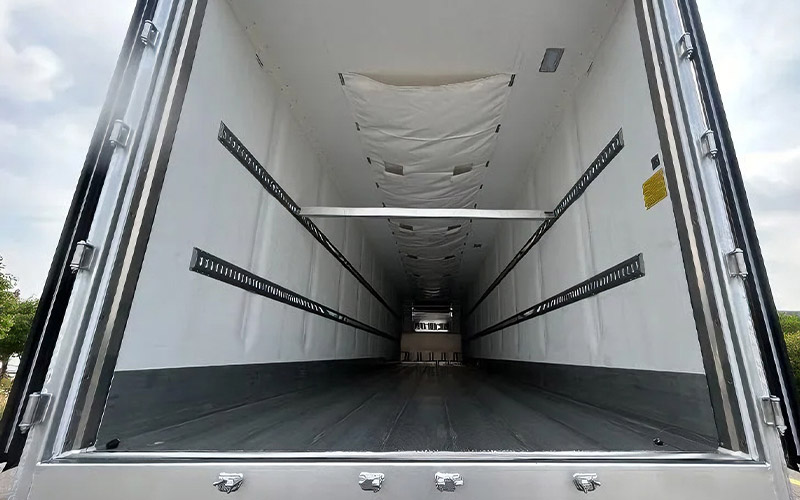
The outside length of a refrigerated body does not describe its usable load space. Insulated walls, the front bulkhead, evaporator projection, door hardware and any internal partition all occupy space that a pallet planner needs to reserve. For refrigerated trailer dimensions, ask for a dimensioned interior drawing showing the narrowest clear width and the lowest usable height, rather than accepting a single nominal measurement. A layout that works in the main aisle can still fail at the rear door or beneath a return-air duct.
Map the actual packaging footprint, including overhang and stretch wrap. Then draw the air-return path around the load and mark the loading tolerance needed by the forklift operator. Evaluate refrigerated trailer dimensions against that usable arrangement. If a supplier changes panel thickness or adds a movable bulkhead after quotation, repeat the pallet layout before approving the revision. This catches a capacity loss while it is still a drawing issue, instead of discovering it when a full shipment is waiting.
Preserve supply and return airflow through the load for refrigerated trailer dimensions
A cold box can show the requested setpoint while part of the cargo receives insufficient circulation. Pallets placed against a bulkhead, blocked floor channels or packaging above the intended load line can interrupt the airflow pattern. When specifying refrigerated trailer dimensions, request a loading diagram that identifies the supply path, the return path and the clearances required by the particular body and refrigeration arrangement. Those clearances need to be visible to loaders, not buried in a maintenance manual.
Test the layout using the tallest and widest packaging that the fleet actually handles. Examine whether mixed-height pallets or hanging loads create short circuits in the airflow. For refrigerated trailer dimensions, the acceptance discussion should include how the proposed layout will be checked under a representative load. An empty-body temperature result cannot by itself establish cargo-temperature uniformity. Record the agreed loading restrictions alongside the interior measurements and revisit them whenever packaging or route conditions change.
Assess doors, docks and unloading interruptions for refrigerated trailer dimensions
Rear-door geometry and loading-dock fit affect the amount of time a refrigerated body remains open. A door that cannot swing clear at a constrained dock can turn a routine stop into a prolonged unloading interruption. Compare refrigerated trailer dimensions with the receiving sites: dock height, approach space, leveller contact, door-opening clearance and the position of protective buffers. Document side-door requirements separately because additional openings change the loading sequence and the thermal duty.
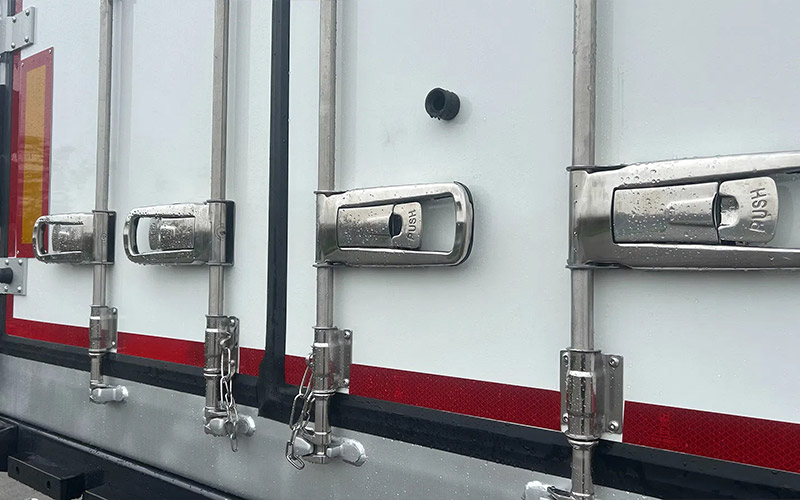
Arrange an operator review of the proposed door hardware, holdbacks and access steps before the body drawing is frozen. For refrigerated trailer dimensions, choose a closure arrangement that crews can operate reliably while wearing the clothing and gloves used on the route. Inspection access matters too: damaged seals or difficult latches should be detectable before dispatch. The procurement decision should reflect how the body works during an actual delivery, rather than how much space it appears to offer when parked with every door open.
Plan partitions for genuinely different temperature duties
A multi-temperature body needs more than a removable divider. Product groups can require different setpoints, loading sequences and access patterns, while the partition itself must seal and remain in the intended position. For refrigerated trailer dimensions, describe the quantity and packaging of each commodity and the order in which it leaves the trailer. A layout that is efficient for the first stop may expose the remaining load to unnecessary door openings later in the route.
Ask for a drawing of the temperature zones and the associated air paths, controls and access restrictions. Evaluate refrigerated trailer dimensions with the partition at its most demanding operating position, rather than only at the centre of an empty body. Confirm the clearance needed to move and secure the divider and how crews check the seal. Changes in zone volume or loading order should trigger a review of refrigeration performance, because the original proposal may depend on a particular distribution of cargo.
Use floor loading criteria that match handling equipment
Refrigerated floors carry both the freight and the concentrated loads imposed during loading. A forklift wheel can apply a very different local demand from a uniformly spread pallet load. When comparing refrigerated trailer dimensions, provide the handling equipment mass, wheel arrangement and intended travel path. Ask for the floor specification and the stated loading limits at the rear entry, along the main aisle and around any recessed or drained areas.
Include surface finish and drainage in the discussion. For refrigerated trailer dimensions, a floor should support the agreed hygiene routine without making routine handling unnecessarily difficult. Confirm how repairable sections are accessed, how water is prevented from remaining in vulnerable details and which loading practices are excluded. The acceptance inspection should compare the fitted floor with the approved drawing and material specification. Do not infer forklift compatibility from the trailer's overall payload statement; the local floor rating needs its own confirmation.
Write a representative thermal acceptance plan
Procurement teams should agree on the acceptance method before the trailer is completed. State the ambient conditions to be recorded, the initial condition of the body, the measurement equipment and the duration of the observation. For refrigerated trailer dimensions, distinguish an empty-body functional check from a representative loaded operating assessment. Both can be useful, but they answer different questions and should not be presented as interchangeable evidence.
Record the location of each sensor and retain the original time-stamped results. When evaluating refrigerated trailer dimensions, discuss how door events, defrost operation and interruptions will be noted during the test. Set acceptance criteria with the cargo owner and the equipment supplier for the intended duty. If conditions differ materially from the agreement, document the limitation and decide whether another assessment is needed. This produces a reviewable handover record instead of a single photograph of a controller displaying an attractive temperature.
Translate a custom-body request into controlled drawings
Customization is most effective when every requested feature has an owner, a drawing reference and an acceptance check. A sales description such as extra-wide interior can leave uncertainty about door openings, wall thickness and legal outside dimensions. For refrigerated trailer dimensions, mark the required features on one controlled layout, including partitions, internal rails, power points, protective surfaces and service access. Identify which dimensions are mandatory and which are preferences that engineering can discuss.
Before approving refrigerated trailer dimensions, reconcile the drawing with the equipment list and the commercial quotation. A feature shown in a rendering may be optional or may have changed during engineering. Keep revisions traceable and obtain confirmation of the final ready-to-operate mass and interior envelope. At handover, check the fitted configuration against the approved revision. This gives the fleet a useful baseline for repairs, future orders and discussions about a proposed change in cargo.
Turn the enquiry into a controlled specification
A useful enquiry separates mandatory operating requirements from preferences that the supplier can discuss. For refrigerated trailer dimensions, identify the cargo, route, handling method and destination before choosing optional equipment. Put the agreed requirements on a controlled specification with a revision date. This gives commercial and engineering teams a common reference and makes a later change visible.
For refrigerated trailer dimensions, ask suppliers to mark deviations rather than responding with a general statement that they can customise anything. Link drawings and equipment lists to the same revision and identify the party responsible for confirming each interface. When an option is changed, review its effect on mass, access, maintenance and the operating process. A traceable specification makes quotations easier to compare and provides a practical acceptance baseline when the finished trailer is inspected.
Compare refrigerated trailer dimensions: decision evidence
| Decision | Evidence to request | Buyer action |
|---|---|---|
| Pallet footprint | Actual wrapped package measurements | Draw the largest routine arrangement |
| Rear opening | Clear door dimensions and loading approach | Check passage before counting positions |
| Air path | Supplier loading-clearance drawing | Reserve supply and return space |
| Final body | Approved fitted interior revision | Repeat layout after panel or partition changes |
Use this comparison as a project record for refrigerated trailer dimensions. Each answer should refer to the same cargo and configuration, with deviations identified explicitly. Where the supplier proposes an alternative, assess its effect on pallet layout and usable interior space before accepting a lower price or a different delivery scope.
Connect the enquiry to a suitable Yufei product
Yufei lists the Semi-remorque frigorifique HFV9400XLC as a relevant starting point for this enquiry. Use the Transport de denrées alimentaires périssables solution page to frame the operating discussion, then request confirmation of the exact configuration, included options and evidence needed for your duty. Illustrative photographs show visible features and do not establish an unshown specification.
Further reading: FDA sanitary transportation guidance.
Request a configuration review and quotation
Discuss refrigerated trailer dimensions with Yufei using your cargo, destination and route information. Include the evidence listed above, identify the decision about pallet layout and usable interior space, and ask for a configuration and quotation that state the included scope. Contact Yufei or complete the enquiry form below to begin the technical discussion.
Frequently asked questions
What should I confirm first when reviewing refrigerated trailer dimensions?
Start with pallet layout and usable interior space. Obtain actual wrapped package measurements and use it to draw the largest routine arrangement. For refrigerated trailer dimensions, this establishes the working case before price or optional equipment is compared.
Which evidence matters most for refrigerated trailer dimensions?
Request clear door dimensions and loading approach and supplier loading-clearance drawing. The documents should describe the actual cargo, interfaces and fitted configuration. Keep the approved revision available so the receiving team can verify what was ordered.
Can a product image prove the requested configuration?
No. A photograph shows visible features. Assess refrigerated trailer dimensions using the specification and appropriate evidence for the intended duty. Confirm unshown options, ratings and compatibility in writing rather than inferring them from appearance.
How should I compare quotations for refrigerated trailer dimensions?
Use the same operating case and included scope. In particular, repeat layout after panel or partition changes using approved fitted interior revision. Identify deviations and exclusions before ranking price, and include the support needed to put the equipment into service.
What information should I send Yufei for a technical enquiry?
Send the cargo description, destination, route, handling method and the specific decision about pallet layout and usable interior space. Include actual wrapped package measurements and clear door dimensions and loading approach where available. Ask Yufei to confirm the proposed product and any required options before ordering.


Catégories de blogs
Nous contacter
Dernières nouvelles
-

Semi Trailer Types Explained for Different Transport Industries
-

Long Cargo Transport Checklist for Steel, Pipe, and Precast Loads
-

Solutions personnalisées de semi-remorques et véhicules spéciaux pour le transport moderne
-

Remorque à col de cygne détachable : Guide pratique pour le transport d'équipements lourds
-
Tanker Semi Trailer Baffle Planning for Liquid Cargo Stability
-

Semi Trailer Maintenance Records Guide for Fleet Buyers
-

Yufei reçoit le titre de “PME spécialisée”, une référence en matière de solidité
-

Trailer Export Inspection Checklist for Overseas Buyers
-

Container Chassis Twist Lock Inspection Guide for Port Fleets
-

Transport de poudre en vrac : Citerne à poudre Yufei, zéro perte
-

Semi Trailer Load Distribution Guide for Safer Heavy Cargo Transport
-
Semi Trailer Spare Parts Planning for Fleet Maintenance Teams
-

Personnalisation de Yufei : Reconstruire la valeur du transport
-

Camions semi-remorques : Comment choisir le bon pour votre entreprise
-

Semi-remorques hydrauliques : Comment choisir le bon modèle
-
Dump Semi Trailer Hydraulic Cylinder Checks Before Site Work
-
Semi-remorques hydrauliques en 2026 : un paysage en pleine évolution
Voir nos solutions sectorielles
Ou découvrez d'autres contenus de l'industrie
Table des matières
For refrigerated trailer dimensions, the purchasing decision is about pallet layout and usable interior space. Start with the real operating case and require evidence for the interfaces that determine whether the equipment will fit the work. This guide connects refrigerated trailer dimensions with the information a fleet buyer can request, compare and retain before approving a configuration.
Define the job for refrigerated trailer dimensions
A pallet layout can pass a simple length-and-width calculation and still fail at the rear opening. The buying task is to establish a usable envelope that includes insulation, obstructions and circulation space. Begin with the largest routine pallet and the narrowest passage it must cross. Keep the forklift approach, packaging overhang and door clearance on the same drawing. The useful outcome is an approved arrangement that loaders can repeat, with a clear rule for reviewing a new package size.
Turn the buying question into acceptance evidence
First, establish pallet footprint. Request actual wrapped package measurements and draw the largest routine arrangement.
Next, resolve rear opening. Request clear door dimensions and loading approach and check passage before counting positions.
Then, review air path. Request supplier loading-clearance drawing and reserve supply and return space.
Finally, document final body. Request approved fitted interior revision and repeat layout after panel or partition changes.
For refrigerated trailer dimensions, these four items define the technical comparison. Keep each answer linked to the same operating case and final configuration. Record missing evidence explicitly, so the receiving team can distinguish an agreed requirement from an unresolved assumption.
Separate the cargo envelope from the outside box for refrigerated trailer dimensions
The outside length of a refrigerated body does not describe its usable load space. Insulated walls, the front bulkhead, evaporator projection, door hardware and any internal partition all occupy space that a pallet planner needs to reserve. For refrigerated trailer dimensions, ask for a dimensioned interior drawing showing the narrowest clear width and the lowest usable height, rather than accepting a single nominal measurement. A layout that works in the main aisle can still fail at the rear door or beneath a return-air duct.
Map the actual packaging footprint, including overhang and stretch wrap. Then draw the air-return path around the load and mark the loading tolerance needed by the forklift operator. Evaluate refrigerated trailer dimensions against that usable arrangement. If a supplier changes panel thickness or adds a movable bulkhead after quotation, repeat the pallet layout before approving the revision. This catches a capacity loss while it is still a drawing issue, instead of discovering it when a full shipment is waiting.
Preserve supply and return airflow through the load for refrigerated trailer dimensions
A cold box can show the requested setpoint while part of the cargo receives insufficient circulation. Pallets placed against a bulkhead, blocked floor channels or packaging above the intended load line can interrupt the airflow pattern. When specifying refrigerated trailer dimensions, request a loading diagram that identifies the supply path, the return path and the clearances required by the particular body and refrigeration arrangement. Those clearances need to be visible to loaders, not buried in a maintenance manual.
Test the layout using the tallest and widest packaging that the fleet actually handles. Examine whether mixed-height pallets or hanging loads create short circuits in the airflow. For refrigerated trailer dimensions, the acceptance discussion should include how the proposed layout will be checked under a representative load. An empty-body temperature result cannot by itself establish cargo-temperature uniformity. Record the agreed loading restrictions alongside the interior measurements and revisit them whenever packaging or route conditions change.
Assess doors, docks and unloading interruptions for refrigerated trailer dimensions
Rear-door geometry and loading-dock fit affect the amount of time a refrigerated body remains open. A door that cannot swing clear at a constrained dock can turn a routine stop into a prolonged unloading interruption. Compare refrigerated trailer dimensions with the receiving sites: dock height, approach space, leveller contact, door-opening clearance and the position of protective buffers. Document side-door requirements separately because additional openings change the loading sequence and the thermal duty.
Arrange an operator review of the proposed door hardware, holdbacks and access steps before the body drawing is frozen. For refrigerated trailer dimensions, choose a closure arrangement that crews can operate reliably while wearing the clothing and gloves used on the route. Inspection access matters too: damaged seals or difficult latches should be detectable before dispatch. The procurement decision should reflect how the body works during an actual delivery, rather than how much space it appears to offer when parked with every door open.
Plan partitions for genuinely different temperature duties
A multi-temperature body needs more than a removable divider. Product groups can require different setpoints, loading sequences and access patterns, while the partition itself must seal and remain in the intended position. For refrigerated trailer dimensions, describe the quantity and packaging of each commodity and the order in which it leaves the trailer. A layout that is efficient for the first stop may expose the remaining load to unnecessary door openings later in the route.
Ask for a drawing of the temperature zones and the associated air paths, controls and access restrictions. Evaluate refrigerated trailer dimensions with the partition at its most demanding operating position, rather than only at the centre of an empty body. Confirm the clearance needed to move and secure the divider and how crews check the seal. Changes in zone volume or loading order should trigger a review of refrigeration performance, because the original proposal may depend on a particular distribution of cargo.
Use floor loading criteria that match handling equipment
Refrigerated floors carry both the freight and the concentrated loads imposed during loading. A forklift wheel can apply a very different local demand from a uniformly spread pallet load. When comparing refrigerated trailer dimensions, provide the handling equipment mass, wheel arrangement and intended travel path. Ask for the floor specification and the stated loading limits at the rear entry, along the main aisle and around any recessed or drained areas.
Include surface finish and drainage in the discussion. For refrigerated trailer dimensions, a floor should support the agreed hygiene routine without making routine handling unnecessarily difficult. Confirm how repairable sections are accessed, how water is prevented from remaining in vulnerable details and which loading practices are excluded. The acceptance inspection should compare the fitted floor with the approved drawing and material specification. Do not infer forklift compatibility from the trailer's overall payload statement; the local floor rating needs its own confirmation.
Write a representative thermal acceptance plan
Procurement teams should agree on the acceptance method before the trailer is completed. State the ambient conditions to be recorded, the initial condition of the body, the measurement equipment and the duration of the observation. For refrigerated trailer dimensions, distinguish an empty-body functional check from a representative loaded operating assessment. Both can be useful, but they answer different questions and should not be presented as interchangeable evidence.
Record the location of each sensor and retain the original time-stamped results. When evaluating refrigerated trailer dimensions, discuss how door events, defrost operation and interruptions will be noted during the test. Set acceptance criteria with the cargo owner and the equipment supplier for the intended duty. If conditions differ materially from the agreement, document the limitation and decide whether another assessment is needed. This produces a reviewable handover record instead of a single photograph of a controller displaying an attractive temperature.
Translate a custom-body request into controlled drawings
Customization is most effective when every requested feature has an owner, a drawing reference and an acceptance check. A sales description such as extra-wide interior can leave uncertainty about door openings, wall thickness and legal outside dimensions. For refrigerated trailer dimensions, mark the required features on one controlled layout, including partitions, internal rails, power points, protective surfaces and service access. Identify which dimensions are mandatory and which are preferences that engineering can discuss.
Before approving refrigerated trailer dimensions, reconcile the drawing with the equipment list and the commercial quotation. A feature shown in a rendering may be optional or may have changed during engineering. Keep revisions traceable and obtain confirmation of the final ready-to-operate mass and interior envelope. At handover, check the fitted configuration against the approved revision. This gives the fleet a useful baseline for repairs, future orders and discussions about a proposed change in cargo.
Turn the enquiry into a controlled specification
A useful enquiry separates mandatory operating requirements from preferences that the supplier can discuss. For refrigerated trailer dimensions, identify the cargo, route, handling method and destination before choosing optional equipment. Put the agreed requirements on a controlled specification with a revision date. This gives commercial and engineering teams a common reference and makes a later change visible.
For refrigerated trailer dimensions, ask suppliers to mark deviations rather than responding with a general statement that they can customise anything. Link drawings and equipment lists to the same revision and identify the party responsible for confirming each interface. When an option is changed, review its effect on mass, access, maintenance and the operating process. A traceable specification makes quotations easier to compare and provides a practical acceptance baseline when the finished trailer is inspected.
Compare refrigerated trailer dimensions: decision evidence
| Decision | Evidence to request | Buyer action |
|---|---|---|
| Pallet footprint | Actual wrapped package measurements | Draw the largest routine arrangement |
| Rear opening | Clear door dimensions and loading approach | Check passage before counting positions |
| Air path | Supplier loading-clearance drawing | Reserve supply and return space |
| Final body | Approved fitted interior revision | Repeat layout after panel or partition changes |
Use this comparison as a project record for refrigerated trailer dimensions. Each answer should refer to the same cargo and configuration, with deviations identified explicitly. Where the supplier proposes an alternative, assess its effect on pallet layout and usable interior space before accepting a lower price or a different delivery scope.
Connect the enquiry to a suitable Yufei product
Yufei lists the Semi-remorque frigorifique HFV9400XLC as a relevant starting point for this enquiry. Use the Transport de denrées alimentaires périssables solution page to frame the operating discussion, then request confirmation of the exact configuration, included options and evidence needed for your duty. Illustrative photographs show visible features and do not establish an unshown specification.
Further reading: FDA sanitary transportation guidance.
Request a configuration review and quotation
Discuss refrigerated trailer dimensions with Yufei using your cargo, destination and route information. Include the evidence listed above, identify the decision about pallet layout and usable interior space, and ask for a configuration and quotation that state the included scope. Contact Yufei or complete the enquiry form below to begin the technical discussion.
Frequently asked questions
What should I confirm first when reviewing refrigerated trailer dimensions?
Start with pallet layout and usable interior space. Obtain actual wrapped package measurements and use it to draw the largest routine arrangement. For refrigerated trailer dimensions, this establishes the working case before price or optional equipment is compared.
Which evidence matters most for refrigerated trailer dimensions?
Request clear door dimensions and loading approach and supplier loading-clearance drawing. The documents should describe the actual cargo, interfaces and fitted configuration. Keep the approved revision available so the receiving team can verify what was ordered.
Can a product image prove the requested configuration?
No. A photograph shows visible features. Assess refrigerated trailer dimensions using the specification and appropriate evidence for the intended duty. Confirm unshown options, ratings and compatibility in writing rather than inferring them from appearance.
How should I compare quotations for refrigerated trailer dimensions?
Use the same operating case and included scope. In particular, repeat layout after panel or partition changes using approved fitted interior revision. Identify deviations and exclusions before ranking price, and include the support needed to put the equipment into service.
What information should I send Yufei for a technical enquiry?
Send the cargo description, destination, route, handling method and the specific decision about pallet layout and usable interior space. Include actual wrapped package measurements and clear door dimensions and loading approach where available. Ask Yufei to confirm the proposed product and any required options before ordering.
Catégories de blogs
Nous contacter
Dernières nouvelles
-
Semi Trailer Shipping Protection Guide for Overseas Buyers
-
Tanker Trailer Unloading Hose Guide for Fleet Operators
-

Haute saison du commerce électronique : la remorque à ridelles de Yufei double l'efficacité.
-

Semi Trailer Landing Gear Inspection Checklist for Safer Yard Operations
-
Container Chassis Selection Guide for Port and Inland Freight
-
Semi Trailer Tire Maintenance Checklist for Long-Distance Fleets
-
Semi Trailer Corrosion Protection Guide for Wet and Coastal Routes
-

Remorque surbaissée ou remorque plate : laquelle convient le mieux à vos besoins de transport
-

Rear Dump Trailer Stability Checklist Before Unloading Loose Material
-
Camions semi-remorques : Comment choisir le bon pour votre entreprise
-
Applications de remorques surbaissées pour le transport d'équipements lourds
-
Dump Semi Trailer Hydraulic Cylinder Checks Before Site Work
-
Semi Trailer Fleet Inspection Calendar for Monthly Maintenance Planning
-
Hydraulic Trailer System Inspection Guide for Heavy Haul Work
-
Fabricant de remorques surbaissées : Comment choisir le bon partenaire pour le transport d'équipement lourd
-

Camions semi-remorques : Comment choisir le bon pour votre entreprise
-
Remorque à col de cygne détachable : Guide pratique pour le transport d'équipements lourds
-

Side Curtain Trailer Maintenance Checklist for Palletized Freight Fleets
Voir nos solutions sectorielles
Ou découvrez d'autres contenus de l'industrie
Ingénierie Équipement Transport :
Les remorques sur mesure offrent des solutions efficaces
Yufei résout les problèmes liés au transport des équipements techniques pour une société de location d'équipements de la province de Henan :
Points douloureux pour le client :
Capacité de transport insuffisante pour les excavateurs de 35 tonnes, retards dus aux faibles capacités de virage sur les routes étroites des chantiers, et délais de livraison des remorques dépassant 45 jours.
Solution :
Remorques surbaissées personnalisées de 80 tonnes avec plate-forme de chargement de 1,2 mètre et direction hydraulique, avec des lignes de production flexibles pour une livraison rapide.

Transport de matières dangereuses :
Les camions-citernes de classe A renforcent la sécurité et augmentent les bénéfices
Yufei a résolu un défi majeur pour son partenaire logistique, Sinopec, en matière de transport de matières dangereuses :
Points douloureux pour le client :
Les vieux camions-citernes présentent des risques de fuite importants, un poids propre de 12 tonnes limite la capacité de chargement et la consommation de carburant dépasse 35 litres.
Solution :
Le camion-citerne de classe A est équipé d'une cuve en acier inoxydable 304, de triples dispositifs de sécurité et d'une structure légère en 0690.

Logistique générale :
La remorque à pieux résout les problèmes de capacité de transport
Yufei aide une entreprise de logistique de Shandong à surmonter les problèmes de transport pendant les périodes de pointe du commerce électronique :
Points douloureux pour le client :
Les vieilles remorques ont des temps de chargement et de déchargement lents, une capacité limitée pour les marchandises volumineuses, une consommation de carburant supérieure à 32 litres et une capacité de transport insuffisante pendant les saisons de pointe.
Solution :
Remorques à ridelles pliables personnalisables, construction légère en acier Q690 + auto-déchargement hydraulique.

[Études de cas clients]
Les solutions personnalisées de Yufei
Basée à Liangshan, la société Yufei est spécialisée dans les semi-remorques à usage spécial depuis 2008, et ses capacités de fabrication intelligente sont démontrées par des cas de service réels dans le monde entier.
[Études de cas clients]
Les solutions personnalisées de Yufei
Basée à Liangshan, la société Yufei est spécialisée dans les semi-remorques à usage spécial depuis 2008, et ses capacités de fabrication intelligente sont démontrées par des cas de service réels dans le monde entier.
Ingénierie Équipement Transport :
Les remorques sur mesure offrent des solutions efficaces
Yufei résout les problèmes liés au transport des équipements techniques pour une société de location d'équipements de la province de Henan :
Points douloureux pour le client :
Capacité de transport insuffisante pour les excavateurs de 35 tonnes, retards dus aux faibles capacités de virage sur les routes étroites des chantiers, et délais de livraison des remorques dépassant 45 jours.
Solution :
Remorques surbaissées personnalisées de 80 tonnes avec plate-forme de chargement de 1,2 mètre et direction hydraulique, avec des lignes de production flexibles pour une livraison rapide.
Transport de matières dangereuses :
Les camions-citernes de classe A renforcent la sécurité et augmentent les bénéfices
Yufei a résolu un défi majeur pour son partenaire logistique, Sinopec, en matière de transport de matières dangereuses :
Points douloureux pour le client :
Les vieux camions-citernes présentent des risques de fuite importants, un poids propre de 12 tonnes limite la capacité de chargement et la consommation de carburant dépasse 35 litres.
Solution :
Le camion-citerne de classe A est équipé d'une cuve en acier inoxydable 304, de triples dispositifs de sécurité et d'une structure légère en 0690.
Logistique générale :
La remorque à pieux résout les problèmes de capacité de transport
Yufei aide une entreprise de logistique de Shandong à surmonter les problèmes de transport pendant les périodes de pointe du commerce électronique :
Points douloureux pour le client :
Les vieilles remorques ont des temps de chargement et de déchargement lents, une capacité limitée pour les marchandises volumineuses, une consommation de carburant supérieure à 32 litres et une capacité de transport insuffisante pendant les saisons de pointe.
Solution :
Remorques à ridelles pliables personnalisables, construction légère en acier Q690 + auto-déchargement hydraulique.
[Avantages fondamentaux]
Compétitivité de base
L'intelligence et le service comme moteur
Fort
Équipe R&D:
Une équipe de 120 personnes, 451 titres seniors TTP3T, une technologie de pointe

Intelligent
Fabrication:
Soudage robotisé, garantie de précision 99%+.

Rapide
Personnalisation:
Lignes flexibles pour des besoins divers, livraison en 7 jours

Strict
Contrôle de la qualité:
Contrôle de l'ensemble du processus, certifié ISO9001

Complet
Service après-vente:
Réponse sous 24 heures, soutien opérationnel tout au long de la vie

Industriel
Cluster Adv:
Base de Liangshan, chaîne d'approvisionnement efficace

Léger
Percée technologique:
Optimisation de la topologie, réduction du poids de 18%

Compléter
Qualifications:
Certifié CCC, classe A pour les produits dangereux

[Nous contacter]
Prêt à trouver votre
La solution parfaite pour les remorques







