
Semi Trailer Load Distribution Guide for Safer Heavy Cargo Transport
Semi Trailer Load Distribution Guide for Safer Heavy Cargo Transport
Good semi trailer load distribution means placing cargo so total weight, axle load, kingpin load, tire capacity, and deck stress stay within legal and equipment limits. For fleets moving steel, machinery, pallets, or construction equipment, the practical goal is simple: keep heavy items low, centered, and properly supported before tie-down work begins.
Table des matières
A practical semi trailer load distribution plan starts before the forklift moves. Check the cargo weight, confirm the trailer rating, map the heaviest pieces, and leave enough margin for road conditions, braking, and turning.

Why semi trailer load distribution matters before dispatch
Poor semi trailer load distribution can overload axles, shorten tire life, reduce braking control, and create frame stress at concentrated contact points. It can also cause a legal problem if the tractor-trailer combination exceeds permitted axle or gross weight limits.
Cargo securement and weight placement are separate tasks, but they affect each other. The U.S. Federal Motor Carrier Safety Administration explains cargo securement rules for preventing cargo movement in transit, while weight balance helps the vehicle remain controllable before the load ever shifts.
Start with three weight checks
Before loading, treat semi trailer load distribution as a measurement task, not a visual guess. Review these three points with the dispatcher, driver, and loading team.
- Gross trailer weight: total cargo plus trailer weight must stay within rated capacity.
- Axle group load: each axle group needs enough weight for traction without exceeding legal limits.
- Kingpin load: the tractor must carry a suitable share of the load without overloading the fifth wheel or steering axle.
Cargo positioning rules that work
For most freight, semi trailer load distribution improves when the heaviest cargo is placed near the trailer centerline and spread across structural support areas. Avoid placing one dense item on a weak deck zone or too far behind the axle group.
Keep tall cargo stable by placing heavier mass low. Use blocking, dunnage, and direct tie-downs only after the weight position is correct. On open-deck trailers, the loading team should also check whether contact points sit over crossmembers or reinforced deck sections.
Quick load placement table
Use this table when building a semi trailer load distribution plan for common cargo types.
| Cargo situation | Better placement approach | Main risk if ignored |
|---|---|---|
| Single heavy machine | Center it over reinforced deck zones and verify axle weights | Rear overload or poor steering response |
| Long steel or pipe | Spread supports evenly and protect contact points | Frame stress and uneven deck loading |
| Mixed pallet freight | Put dense pallets low and toward the center | Side-to-side imbalance |
| Loose equipment attachments | Group by weight, then secure each item separately | Small items moving under braking |

Match semi trailer load distribution to trailer type
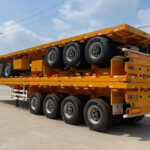
A flatbed, lowbed, stake-side trailer, and container chassis each needs a different loading plan. A lowbed may help lower the cargo center of gravity for machinery, while a flatbed needs careful point-load control across the deck. Buyers comparing equipment can review YF Trailer’s Série de camions semi-remorques to match deck style, axle layout, and cargo type.
Semi trailer load distribution also changes by route. Rough roads, steep grades, bridge limits, and port yards can all affect how much margin the fleet should leave before dispatch.
Dispatch checklist for loading teams
Before release, use a short checklist that the driver and loader can both understand.
- Confirm the cargo weight and dimensions.
- Check trailer rated capacity and deck condition.
- Place heavy cargo low and near the centerline.
- Keep left-right balance as even as practical.
- Verify axle weights where scales are available.
- Add blocking, dunnage, and tie-downs after placement.
- Record the final semi trailer load distribution plan for repeat loads.

Common mistakes to avoid
The most common semi trailer load distribution error is treating tie-down strength as a substitute for proper placement. Securement helps hold cargo in place, but it cannot fix an overloaded axle or a high center of gravity.
Another mistake is copying yesterday’s loading pattern when the cargo mix has changed. Two machines with similar dimensions may have very different operating weights, attachments, or contact points.
When to ask the manufacturer
Ask the trailer manufacturer for guidance when cargo is unusually dense, oversized, or concentrated on a small footprint. Semi trailer load distribution depends on deck structure, axle spacing, suspension, tire rating, and operating route. For recurring freight lanes, the Logistique générale Transport solution page can help teams connect cargo type with a suitable trailer configuration.
Final takeaway
Strong semi trailer load distribution is a repeatable dispatch habit: weigh the cargo, place heavy mass low and centered, protect support points, confirm axle loading, then secure the cargo. When the loading team follows the same process every time, the trailer works closer to its design intent and the driver starts the trip with better control.
FAQ
What is semi trailer load distribution?
It is the way cargo weight is positioned across the trailer deck, axles, kingpin, tires, and frame.
Where should the heaviest cargo go?
Place the heaviest cargo low, close to the centerline, and over areas designed to support concentrated weight.
Does load distribution replace cargo securement?
No. Load distribution balances weight; securement prevents cargo movement. Both are needed before dispatch.
Can the same loading plan be reused?
Only when cargo weight, dimensions, route, and trailer configuration are truly similar.
Who should approve difficult heavy loads?
The fleet manager, driver, loading supervisor, and trailer manufacturer should review unusual or concentrated loads before release.
Catégories de blogs
Nous contacter
Dernières nouvelles
-

Lowboy Trailer Ramp Angle Planning for Construction Machinery
-

Semi Trailer After-Sales Support Checklist for Importers
-
Semi Trailer Spare Parts Planning for Fleet Maintenance Teams
-
Dump Semi Trailer Hydraulic Cylinder Checks Before Site Work
-

Capacité des remorques surbaissées : Guide complet pour le transport d'engins lourds
-

Side Curtain Trailer Loading Access Guide for Pallet Freight
-

Bulk Powder Tanker Loading Plan for Cleaner Dry Bulk Dispatch
-

Semi-remorques hydrauliques en 2026 : un paysage en pleine évolution
-

Rear Dump Semi Trailer Selection Guide for Aggregate and Jobsite Work
-

Yufei coopère avec un groupe de logistique pour créer un écosystème de transport
-
Bulk Powder Tanker Air Line Inspection Before Dry Bulk Loading
-
Guide des remorques à essieux multiples pour le transport d'équipements lourds
-
Semi Trailer Wheel Bearing Inspection Guide for Long-Distance Fleets
-
Bulk Powder Tanker Air Compressor Matching Guide
-
Semi Trailer Frame Inspection Guide for Heavy-Duty Buyers
-

Container Chassis Inspection Checklist Before Port Dispatch
-
Lowbed Trailer Route Survey Checklist for Heavy Equipment Moves
-
Side Curtain Trailer Maintenance Checklist for Palletized Freight Fleets
Voir nos solutions sectorielles
Ou découvrez d'autres contenus de l'industrie
Good semi trailer load distribution means placing cargo so total weight, axle load, kingpin load, tire capacity, and deck stress stay within legal and equipment limits. For fleets moving steel, machinery, pallets, or construction equipment, the practical goal is simple: keep heavy items low, centered, and properly supported before tie-down work begins.
Table des matières
A practical semi trailer load distribution plan starts before the forklift moves. Check the cargo weight, confirm the trailer rating, map the heaviest pieces, and leave enough margin for road conditions, braking, and turning.
Why semi trailer load distribution matters before dispatch
Poor semi trailer load distribution can overload axles, shorten tire life, reduce braking control, and create frame stress at concentrated contact points. It can also cause a legal problem if the tractor-trailer combination exceeds permitted axle or gross weight limits.
Cargo securement and weight placement are separate tasks, but they affect each other. The U.S. Federal Motor Carrier Safety Administration explains cargo securement rules for preventing cargo movement in transit, while weight balance helps the vehicle remain controllable before the load ever shifts.
Start with three weight checks
Before loading, treat semi trailer load distribution as a measurement task, not a visual guess. Review these three points with the dispatcher, driver, and loading team.
- Gross trailer weight: total cargo plus trailer weight must stay within rated capacity.
- Axle group load: each axle group needs enough weight for traction without exceeding legal limits.
- Kingpin load: the tractor must carry a suitable share of the load without overloading the fifth wheel or steering axle.
Cargo positioning rules that work
For most freight, semi trailer load distribution improves when the heaviest cargo is placed near the trailer centerline and spread across structural support areas. Avoid placing one dense item on a weak deck zone or too far behind the axle group.
Keep tall cargo stable by placing heavier mass low. Use blocking, dunnage, and direct tie-downs only after the weight position is correct. On open-deck trailers, the loading team should also check whether contact points sit over crossmembers or reinforced deck sections.
Quick load placement table
Use this table when building a semi trailer load distribution plan for common cargo types.
| Cargo situation | Better placement approach | Main risk if ignored |
|---|---|---|
| Single heavy machine | Center it over reinforced deck zones and verify axle weights | Rear overload or poor steering response |
| Long steel or pipe | Spread supports evenly and protect contact points | Frame stress and uneven deck loading |
| Mixed pallet freight | Put dense pallets low and toward the center | Side-to-side imbalance |
| Loose equipment attachments | Group by weight, then secure each item separately | Small items moving under braking |
Match semi trailer load distribution to trailer type
A flatbed, lowbed, stake-side trailer, and container chassis each needs a different loading plan. A lowbed may help lower the cargo center of gravity for machinery, while a flatbed needs careful point-load control across the deck. Buyers comparing equipment can review YF Trailer’s Série de camions semi-remorques to match deck style, axle layout, and cargo type.
Semi trailer load distribution also changes by route. Rough roads, steep grades, bridge limits, and port yards can all affect how much margin the fleet should leave before dispatch.
Dispatch checklist for loading teams
Before release, use a short checklist that the driver and loader can both understand.
- Confirm the cargo weight and dimensions.
- Check trailer rated capacity and deck condition.
- Place heavy cargo low and near the centerline.
- Keep left-right balance as even as practical.
- Verify axle weights where scales are available.
- Add blocking, dunnage, and tie-downs after placement.
- Record the final semi trailer load distribution plan for repeat loads.
Common mistakes to avoid
The most common semi trailer load distribution error is treating tie-down strength as a substitute for proper placement. Securement helps hold cargo in place, but it cannot fix an overloaded axle or a high center of gravity.
Another mistake is copying yesterday’s loading pattern when the cargo mix has changed. Two machines with similar dimensions may have very different operating weights, attachments, or contact points.
When to ask the manufacturer
Ask the trailer manufacturer for guidance when cargo is unusually dense, oversized, or concentrated on a small footprint. Semi trailer load distribution depends on deck structure, axle spacing, suspension, tire rating, and operating route. For recurring freight lanes, the Logistique générale Transport solution page can help teams connect cargo type with a suitable trailer configuration.
Final takeaway
Strong semi trailer load distribution is a repeatable dispatch habit: weigh the cargo, place heavy mass low and centered, protect support points, confirm axle loading, then secure the cargo. When the loading team follows the same process every time, the trailer works closer to its design intent and the driver starts the trip with better control.
FAQ
What is semi trailer load distribution?
It is the way cargo weight is positioned across the trailer deck, axles, kingpin, tires, and frame.
Where should the heaviest cargo go?
Place the heaviest cargo low, close to the centerline, and over areas designed to support concentrated weight.
Does load distribution replace cargo securement?
No. Load distribution balances weight; securement prevents cargo movement. Both are needed before dispatch.
Can the same loading plan be reused?
Only when cargo weight, dimensions, route, and trailer configuration are truly similar.
Who should approve difficult heavy loads?
The fleet manager, driver, loading supervisor, and trailer manufacturer should review unusual or concentrated loads before release.
Catégories de blogs
Nous contacter
Dernières nouvelles
-

Remorque à col de cygne détachable : Guide pratique pour le transport d'équipements lourds
-

Flatbed Trailer Loading Checklist for Safer Heavy Equipment Transport
-

Remorque surbaissée ou remorque plate : laquelle convient le mieux à vos besoins de transport
-
Rear Dump Trailer Stability Checklist Before Unloading Loose Material
-
Rear Dump Semi Trailer Selection Guide for Aggregate and Jobsite Work
-
Semi Trailer Spare Parts Planning for Fleet Maintenance Teams
-
Guide des remorques à essieux multiples pour le transport d'équipements lourds
-

La collaboration en matière de chaîne d'approvisionnement et les remorques créent un écosystème entre l'industrie et le monde universitaire
-
Flatbed Trailer Loading Surface Guide for Machinery Buyers
-
Semi Trailer After-Sales Support Checklist for Importers
-
Semi Trailer Maintenance Records Guide for Fleet Buyers
-

Special Purpose Trailer Maintenance Schedule for Fleet Reliability
-

Lancement de la remorque pour charges lourdes Yufei, la technologie au service de la performance
-

Yufei reçoit le titre de “PME spécialisée”, une référence en matière de solidité
-

Tanker Semi Trailer Compartment Planning for Safer Liquid Cargo Dispatch
-

Des charges lourdes sécurisées : Remorque surbaissée Yufei
-
Semi Trailer Types Explained for Different Transport Industries
-
Semi Trailer Load Distribution Guide for Safer Heavy Cargo Transport
Voir nos solutions sectorielles
Ou découvrez d'autres contenus de l'industrie
Ingénierie Équipement Transport :
Les remorques sur mesure offrent des solutions efficaces
Yufei résout les problèmes liés au transport des équipements techniques pour une société de location d'équipements de la province de Henan :
Points douloureux pour le client :
Capacité de transport insuffisante pour les excavateurs de 35 tonnes, retards dus aux faibles capacités de virage sur les routes étroites des chantiers, et délais de livraison des remorques dépassant 45 jours.
Solution :
Remorques surbaissées personnalisées de 80 tonnes avec plate-forme de chargement de 1,2 mètre et direction hydraulique, avec des lignes de production flexibles pour une livraison rapide.

Transport de matières dangereuses :
Les camions-citernes de classe A renforcent la sécurité et augmentent les bénéfices
Yufei a résolu un défi majeur pour son partenaire logistique, Sinopec, en matière de transport de matières dangereuses :
Points douloureux pour le client :
Les vieux camions-citernes présentent des risques de fuite importants, un poids propre de 12 tonnes limite la capacité de chargement et la consommation de carburant dépasse 35 litres.
Solution :
Le camion-citerne de classe A est équipé d'une cuve en acier inoxydable 304, de triples dispositifs de sécurité et d'une structure légère en 0690.

Logistique générale :
La remorque à pieux résout les problèmes de capacité de transport
Yufei aide une entreprise de logistique de Shandong à surmonter les problèmes de transport pendant les périodes de pointe du commerce électronique :
Points douloureux pour le client :
Les vieilles remorques ont des temps de chargement et de déchargement lents, une capacité limitée pour les marchandises volumineuses, une consommation de carburant supérieure à 32 litres et une capacité de transport insuffisante pendant les saisons de pointe.
Solution :
Remorques à ridelles pliables personnalisables, construction légère en acier Q690 + auto-déchargement hydraulique.

[Études de cas clients]
Les solutions personnalisées de Yufei
Basée à Liangshan, la société Yufei est spécialisée dans les semi-remorques à usage spécial depuis 2008, et ses capacités de fabrication intelligente sont démontrées par des cas de service réels dans le monde entier.
[Études de cas clients]
Les solutions personnalisées de Yufei
Basée à Liangshan, la société Yufei est spécialisée dans les semi-remorques à usage spécial depuis 2008, et ses capacités de fabrication intelligente sont démontrées par des cas de service réels dans le monde entier.
Ingénierie Équipement Transport :
Les remorques sur mesure offrent des solutions efficaces
Yufei résout les problèmes liés au transport des équipements techniques pour une société de location d'équipements de la province de Henan :
Points douloureux pour le client :
Capacité de transport insuffisante pour les excavateurs de 35 tonnes, retards dus aux faibles capacités de virage sur les routes étroites des chantiers, et délais de livraison des remorques dépassant 45 jours.
Solution :
Remorques surbaissées personnalisées de 80 tonnes avec plate-forme de chargement de 1,2 mètre et direction hydraulique, avec des lignes de production flexibles pour une livraison rapide.
Transport de matières dangereuses :
Les camions-citernes de classe A renforcent la sécurité et augmentent les bénéfices
Yufei a résolu un défi majeur pour son partenaire logistique, Sinopec, en matière de transport de matières dangereuses :
Points douloureux pour le client :
Les vieux camions-citernes présentent des risques de fuite importants, un poids propre de 12 tonnes limite la capacité de chargement et la consommation de carburant dépasse 35 litres.
Solution :
Le camion-citerne de classe A est équipé d'une cuve en acier inoxydable 304, de triples dispositifs de sécurité et d'une structure légère en 0690.
Logistique générale :
La remorque à pieux résout les problèmes de capacité de transport
Yufei aide une entreprise de logistique de Shandong à surmonter les problèmes de transport pendant les périodes de pointe du commerce électronique :
Points douloureux pour le client :
Les vieilles remorques ont des temps de chargement et de déchargement lents, une capacité limitée pour les marchandises volumineuses, une consommation de carburant supérieure à 32 litres et une capacité de transport insuffisante pendant les saisons de pointe.
Solution :
Remorques à ridelles pliables personnalisables, construction légère en acier Q690 + auto-déchargement hydraulique.
[Avantages fondamentaux]
Compétitivité de base
L'intelligence et le service comme moteur
Fort
Équipe R&D:
Une équipe de 120 personnes, 451 titres seniors TTP3T, une technologie de pointe

Intelligent
Fabrication:
Soudage robotisé, garantie de précision 99%+.

Rapide
Personnalisation:
Lignes flexibles pour des besoins divers, livraison en 7 jours

Strict
Contrôle de la qualité:
Contrôle de l'ensemble du processus, certifié ISO9001

Complet
Service après-vente:
Réponse sous 24 heures, soutien opérationnel tout au long de la vie

Industriel
Cluster Adv:
Base de Liangshan, chaîne d'approvisionnement efficace

Léger
Percée technologique:
Optimisation de la topologie, réduction du poids de 18%

Compléter
Qualifications:
Certifié CCC, classe A pour les produits dangereux

[Nous contacter]
Prêt à trouver votre
La solution parfaite pour les remorques







